Flood Repeat Period Calculation
The repeat period ($T$) of a flood event is the average time interval, in years, between occurrences of floods of equal or greater magnitude. It is inversely related to the probability ($P$) of such an event occurring in any given year.
The relationship is defined as:
$T = \frac{1}{P}$In this problem, the probability ($P$) that water flow will equal or exceed the high flood level this year is given as $0.01$.
Calculation
Substitute the given probability into the formula:
$T = \frac{1}{0.01}$ $T = 100$Therefore, the repeat period of floods that equal or exceed this level is 100 years.
Important Questions from Hydrology And Water Resources
- A river with $2\text{ km}$ wide flood plain and $10\text{ m}$ channel depth flows with a velocity of $2\text{ ms}^{-1}$. What will be flow condition in the river?
Read the following statements and choose the CORRECT answer.
I. The suspended sediment concentration in rivers is supply-limited rather than hydraulically-limited, when
II. Much suspended material is contributed by overland flow from hillslope erosion
III. Suspended material is entirely derived by turbulent diffusion from the channel bed
- With reference to water in the hydrologic cycle, its residence time is the maximum in
Match the basin types A, B and C with the hydrograph patterns P, Q and R
Basin types Hydrograph pattern A. 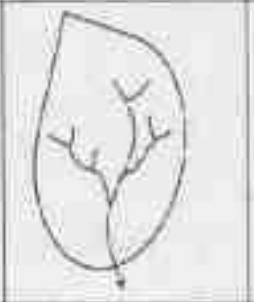
P. 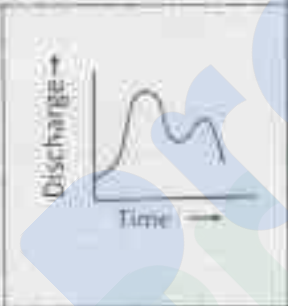
B. 
Q. 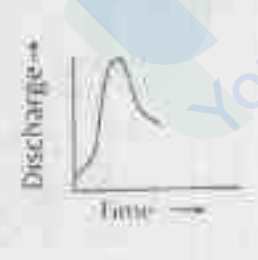
C. 
R. 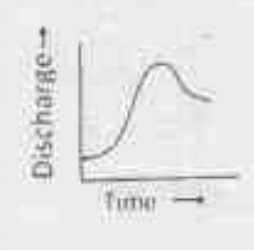
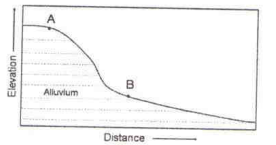
Hydraulic gradient beneath A and B during rainy and dry seasons will