
Determining River Flow Condition Using Froude Number
The flow condition in an open channel, like a river, is determined by comparing the flow velocity to the speed of a small gravity wave. This comparison is quantified using the Froude number ($Fr$).
Froude Number Calculation
The Froude number ($Fr$) is calculated as:
$ Fr = \frac{V}{\sqrt{g \cdot L_h}} $
- $V$ is the average flow velocity.
- $g$ is the acceleration due to gravity ($ \approx 9.81 \text{ ms}^{-2}$).
- $L_h$ is the hydraulic depth.
Hydraulic Depth
For a wide rectangular channel, the hydraulic depth ($L_h$) is approximately equal to the flow depth ($D$). In this problem:
- Flow velocity ($V$) = $2 \text{ ms}^{-1}$
- Channel depth ($D$) = $10 \text{ m}$
- We approximate $L_h \approx D = 10 \text{ m}$.
The flood plain width ($2 \text{ km}$) is significantly larger than the channel depth and typically does not directly influence the Froude number calculation for the main channel flow unless specified otherwise.
Calculating the Froude Number
Substitute the values into the formula:
$ Fr = \frac{2 \text{ ms}^{-1}}{\sqrt{9.81 \text{ ms}^{-2} \cdot 10 \text{ m}}} $
$ Fr = \frac{2}{\sqrt{98.1}} $
$ Fr \approx \frac{2}{9.9045} $
$ Fr \approx 0.2019 $
Interpreting the Froude Number
The calculated Froude number determines the flow condition:
- If $Fr < 1$, the flow is sub-critical (streaming).
- If $Fr = 1$, the flow is critical.
- If $Fr > 1$, the flow is super-critical (shooting).
Since $Fr \approx 0.2019$, which is less than 1, the flow condition is sub-critical.
Important Questions from Hydrology And Water Resources
Read the following statements and choose the CORRECT answer.
I. The suspended sediment concentration in rivers is supply-limited rather than hydraulically-limited, when
II. Much suspended material is contributed by overland flow from hillslope erosion
III. Suspended material is entirely derived by turbulent diffusion from the channel bed
- With reference to water in the hydrologic cycle, its residence time is the maximum in
Match the basin types A, B and C with the hydrograph patterns P, Q and R
Basin types Hydrograph pattern A. 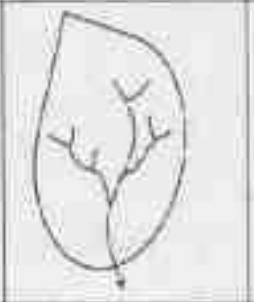
P. 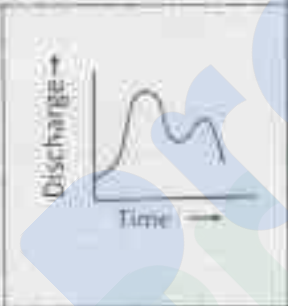
B. 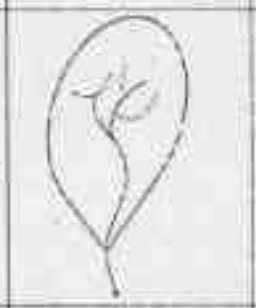
Q. 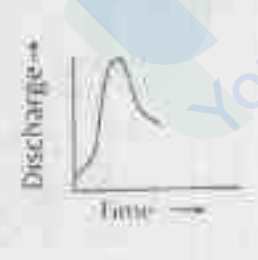
C. 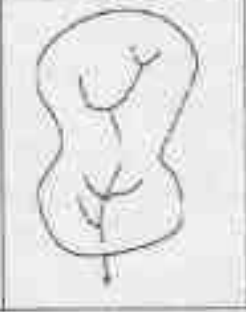
R. 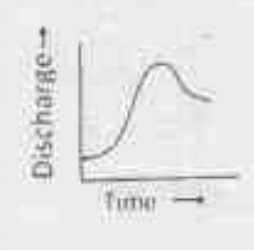
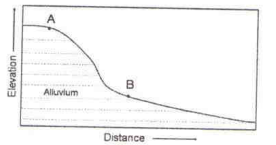
Hydraulic gradient beneath A and B during rainy and dry seasons will
Identify the correct sequence of freshwate abundance on the Earth.(GP = Glaciers and Polar ice; A = Atmosphere; LR = Lakes and Rivers; UW = Underground Water)


