The force between two electric charges is expressed by the equation: F = (k q1 q2) / r2 Which of the following is a correct statement?
The equation applies to point charges
Understanding Coulomb's Law and Point Charges
The question provides the formula for the force between two electric charges, which is known as Coulomb's Law:
\[ F = \frac{k q_1 q_2}{r^2} \]
Here, \(F\) represents the magnitude of the electric force between the two charges. Let's break down the other terms in the equation:
- \(q_1\) and \(q_2\) are the magnitudes of the two electric charges.
- \(r\) is the distance between the centers of the two charges.
- \(k\) is Coulomb's constant, also known as the electrostatic constant. Its approximate value in a vacuum is \(8.98755 \times 10^9 \text{ N m}^2/\text{C}^2\). The value of \(k\) depends on the medium between the charges; in a vacuum, \(k = 1 / (4 \pi \epsilon_0)\), where \(\epsilon_0\) is the permittivity of free space.
Coulomb's Law describes the electrostatic interaction between charged particles. It is a fundamental law in electromagnetism.
Analyzing the Statements about Coulomb's Law
Let's evaluate each given statement based on our understanding of Coulomb's Law and the provided formula \(F = k q_1 q_2 / r^2\).
Statement 1: The equation applies to point charges
Coulomb's Law, in its fundamental form \(F = k q_1 q_2 / r^2\), is an inverse-square law that precisely describes the force between two stationary point charges. A point charge is an idealized model where the charge is concentrated at a single point in space. For extended charge distributions, Coulomb's Law is applied by considering infinitesimal charge elements as point charges and integrating over the distribution. Therefore, this statement is correct. The equation is derived for and directly applies to point charges.
Statement 2: k is Boltzmann’s constant
In the equation \(F = k q_1 q_2 / r^2\), the constant \(k\) is Coulomb's constant. Boltzmann's constant, denoted by \(k_B\) (or sometimes just \(k\)), is a completely different physical constant that relates the average kinetic energy of particles in a gas with the thermodynamic temperature of the gas. Boltzmann's constant is approximately \(1.38 \times 10^{-23} \text{ J/K}\). Thus, this statement is incorrect.
Statement 3: r is the radius of the spheres on which the two charges are placed
In the Coulomb's Law equation \(F = k q_1 q_2 / r^2\), \(r\) represents the distance between the two charges. Specifically, for point charges, \(r\) is the distance between the points where the charges are located. If dealing with uniformly charged spheres, the law applies to the force between their centers, and \(r\) is the distance between the centers of the spheres. However, \(r\) itself is not the radius of the spheres. This statement is incorrect as it misidentifies \(r\).
Statement 4: The equation can only be applied to uniform
This statement is incomplete and grammatically incorrect. Assuming it attempts to refer to some property like "uniform charge distributions" or "uniform fields," the fundamental application of the given formula is to point charges. While Coulomb's Law can be used as a basis to calculate forces involving continuous charge distributions (including uniform ones) through integration, the provided formula \(F = k q_1 q_2 / r^2\) is directly applicable to point charges. The statement is vague and likely incorrect in its intended meaning regarding the primary application of the given formula.
Conclusion
Based on the analysis of each statement, the only correct statement regarding the equation \(F = k q_1 q_2 / r^2\) for the force between two electric charges is that the equation applies to point charges.
| Statement | Analysis | Correctness |
|---|---|---|
| The equation applies to point charges | Coulomb's Law is the fundamental law for the force between point charges. | Correct |
| k is Boltzmann’s constant | \(k\) is Coulomb's constant, not Boltzmann's constant. | Incorrect |
| r is the radius of the spheres... | \(r\) is the distance between the charges/centers, not the radius of spheres. | Incorrect |
| The equation can only be applied to uniform | Statement is incomplete and the formula directly applies to point charges, not limited to 'uniform' distributions. | Incorrect |
Revision Table: Key Concepts of Coulomb's Law
| Concept | Description | Formula/Notes |
|---|---|---|
| Coulomb's Law | Describes the electrostatic force between two stationary point charges. | \( F = \frac{k |q_1 q_2|}{r^2} \) (Magnitude) |
| Point Charge | An idealized charge concentrated at a single point. | Fundamental unit for applying Coulomb's Law. |
| Electric Force (F) | The attractive or repulsive force between charges. Repulsive for like charges, attractive for unlike charges. | Vector quantity; direction is along the line joining the charges. |
| Charges (q1, q2) | Magnitudes of the electric charges. | Measured in Coulombs (C). Can be positive or negative. |
| Distance (r) | Distance between the centers of the point charges. | Measured in meters (m). |
| Coulomb's Constant (k) | Proportionality constant in Coulomb's Law. Depends on the medium. | In vacuum, \( k \approx 8.98755 \times 10^9 \text{ N m}^2/\text{C}^2 \). \( k = 1 / (4 \pi \epsilon_0) \). |
| Permittivity of Free Space (\(\epsilon_0\)) | A measure of the resistance encountered when forming an electric field in a vacuum. | \( \epsilon_0 \approx 8.854 \times 10^{-12} \text{ C}^2/\text{N m}^2 \). |
Additional Information on Electrostatic Force
Coulomb's Law is analogous to Newton's Law of Universal Gravitation, both being inverse-square laws. However, gravitational force is always attractive, while electric force can be attractive or repulsive depending on the signs of the charges.
The vector form of Coulomb's Law gives the direction of the force:
\[ \vec{F}_{12} = \frac{k q_1 q_2}{r^2} \hat{r}_{21} \]
where \( \vec{F}_{12} \) is the force exerted on charge \(q_1\) by charge \(q_2\), \(r\) is the distance between \(q_1\) and \(q_2\), and \( \hat{r}_{21} \) is a unit vector pointing from \(q_2\) to \(q_1\). The sign of the product \(q_1 q_2\) determines the direction of the force relative to the unit vector (attractive if \(q_1 q_2 < 0\), repulsive if \(q_1 q_2 > 0\)).
Superposition Principle: If there are multiple charges, the total force on a single charge is the vector sum of the forces exerted by each of the other charges individually. This principle is crucial for calculating forces in systems with more than two charges.
Important Questions from Electric Charges and Fields
Which of the following options is correct by using Coulomb's law?
Which of the following statements are correct?
- A. The angle at minimum deviation of a prism is greater for violet light than that for red light.
- B. The purpose of microscopes and telescopes is to increase the visual angle.
- C. For the diffraction to take place, the size of aperture or of the obstacle should be comparable to the wavelength of light.
- D. The light scattered in the direction of the incident light is always plane polarized.
- E. The source and its virtual image can behave as coherent sources.
Choose the correct answer from the options given below:
Match List - I with List - II
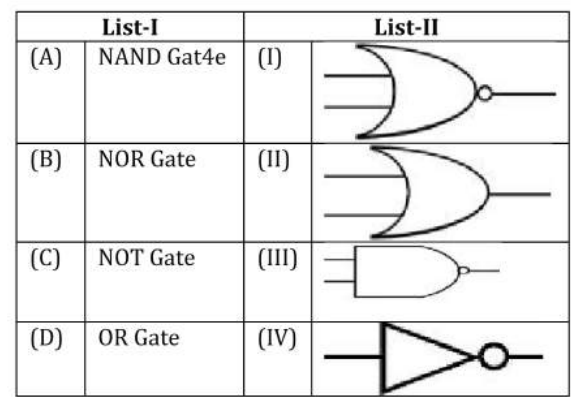
Choose the correct answer from the options given below:
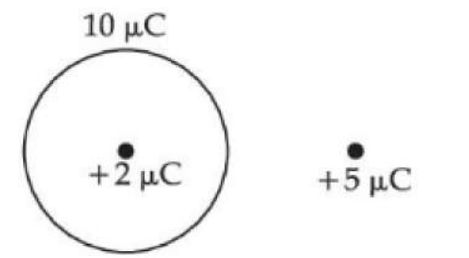
A thin metallic spherical shell contains a charge +10 μC on it. A point charge +2 μC is placed at the centre of the shell and another charge +5 μC is placed outside it as shown. The force on the charge +2 μC at the centre is:
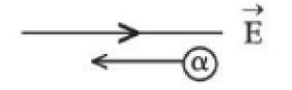
In the figure, an α-particle moves a distance l in a uniform electric field E as shown. Does the Electric Field do a positive or a negative work on the α-particle? Does the electric potential energy of the α-particle increase or decrease?