The following phylogeny shows how species P to T are related to each other. The branch lengths indicate the degree of evolutionary change.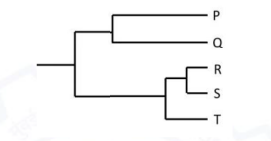
The species composition of three areas is given below
Area 1: PQR; Area 2: RST; Area 3: QRS
Given this information, the phylogenetic diversity of
Area 1 > Area 3 > Area 2
Phylogenetic Diversity (PD) is a measure of biodiversity that calculates the sum of the lengths of all phylogenetic branches that connect a given set of species to a common root. Areas with species that are more evolutionarily distinct (separated by longer branches) have a higher PD.
1. Visual Analysis of Branch Lengths
- In the provided phylogeny, the horizontal length of a branch represents the degree of evolutionary change.
- The branches leading to species P and Q are significantly longer than the branches leading to R, S, and T.
- To maximize PD, an area should contain species separated by the greatest total branch length.
2. Comparing the Area Compositions
- Area 1 (P, Q, R): This area includes the two species with the longest branches (P and Q) and one species from the other major clade (R). Because it captures two long terminal branches and the deep divergence between the two main clades, it has the highest total length. $$\text{PD}_{\text{Area 1}} \rightarrow \text{Maximum}$$
- Area 3 (Q, R, S): This area includes only one of the long branches (Q). The other two species (R and S) are very closely related and have short branches. It spans the main divergence of the tree but lacks the additional length provided by branch P. $$\text{PD}_{\text{Area 1}} > \text{PD}_{\text{Area 3}}$$
- Area 2 (R, S, T): All species in this area belong to the same sub-clade. They are closely related and share very short branch segments. This area misses the entire lineage of P and Q, resulting in the lowest evolutionary "coverage." $$\text{PD}_{\text{Area 3}} > \text{PD}_{\text{Area 2}}$$
Conclusion
Based on the sum of the evolutionary branch lengths for each species set:
Area 1 > Area 3 > Area 2
The correct statement is the first option: Area 1 > Area 3 > Area 2.
Important Questions from Phylogenetic trees
- Newts produce tetrodotoxin (TTX), a poison that targets sodium ion channels, for defense against their predators, garter snakes. Several species of garter snakes are resistant to newt TTX due to specific known amino acid substitutions in garter snake sodium channels. Which one of the following is best-suited to identify whether this adaptation in garter snakes has a single origin or multiple independent origins?
A phylogenetic tree representing the evolutionary relationship between various vertebrates is shown below.
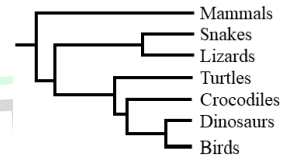
Given this tree topology, which one or more of the following statements is/are correct?A phylogenetic tree for the evolution of two pigmentation traits in species of fish is shown for clades X, Y and Z. Genes A and/or B, if mutated, can cause dark pigmentation in the body.
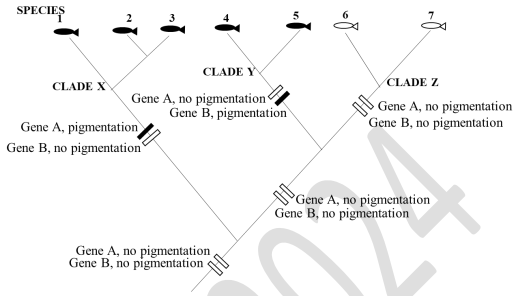
Which one or more of the following statements is/are correct?- Whales and dolphins are hypothesized to have evolved along the northern shore of the Tethys Sea, prior to the Indian plate's collision with the Eurasian plate. To which one of the following animals are these aquatic mammals most closely related?
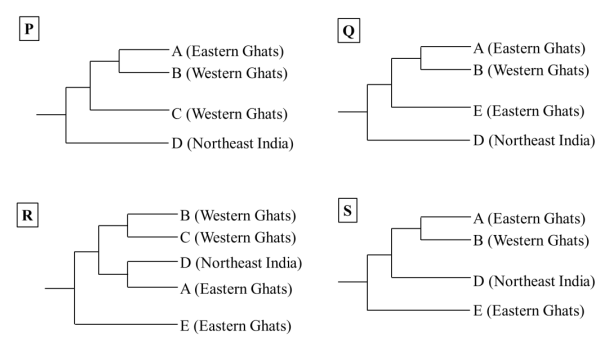
In the phylogenetic trees shown, the tips represent different species of geckos(labeled A to E) and the areas to which they belong. Which one of these is most consistent with the hypothesis that the geckos colonized the Western Ghats from Northeast India through the Eastern Ghats?