In the phylogenetic trees shown, the tips represent different species of geckos(labeled A to E) and the areas to which they belong. Which one of these is most consistent with the hypothesis that the geckos colonized the Western Ghats from Northeast India through the Eastern Ghats? 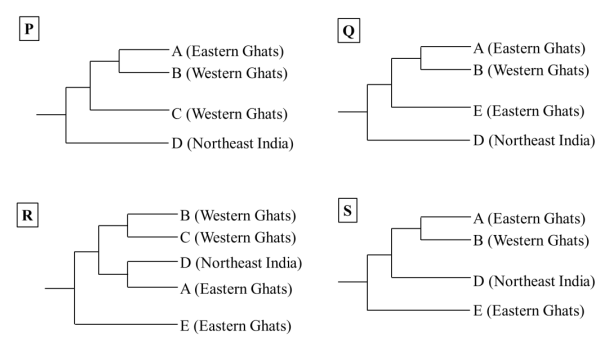
The hypothesis states that geckos colonized the Western Ghats from Northeast India, passing through the Eastern Ghats. This implies a specific sequence of colonization and subsequent diversification based on geographic proximity. In a phylogenetic tree, this would mean:
- Species from Northeast India would be the most basal (earliest diverging) group.
- Species from the Eastern Ghats would diverge next, indicating colonization from Northeast India.
- Species from the Western Ghats would be the most recently diverged group, indicating colonization from the Eastern Ghats.
In simple terms, the branching pattern should reflect the geographic movement: Northeast India $\rightarrow$ Eastern Ghats $\rightarrow$ Western Ghats.
Analyzing each Phylogenetic Tree:
Tree P:
- Most basal branch: D (Northeast India)
- Next branch: C (Western Ghats)
- Next branch: B (Western Ghats)
- Most recent split: A (Eastern Ghats) and B (Western Ghats)
This tree shows D (Northeast India) as the oldest. Then a group leading to C (Western Ghats) diverges. Subsequently, A (Eastern Ghats) and B (Western Ghats) are closely related. This does not follow the correct geographical stepping stone pattern, as Western Ghats species (C) diverge before Eastern Ghats species (A).
Tree Q:
- Most basal branch: D (Northeast India)
- Next branch: E (Eastern Ghats)
- Most recent split: A (Eastern Ghats) and B (Western Ghats)
This tree starts with D (Northeast India) as the oldest, which is consistent. Then E (Eastern Ghats) diverges. Finally, A (Eastern Ghats) and B (Western Ghats) are closely related. This pattern means: Northeast India $\rightarrow$ Eastern Ghats (E) $\rightarrow$ further diversification within Eastern Ghats (A) and Western Ghats (B). This is consistent with the hypothesis.
Tree R:
- Most basal branch: E (Eastern Ghats)
- Next branch: A (Eastern Ghats)
- Then D (Northeast India)
- Then C (Western Ghats)
- Then B (Western Ghats)
This tree shows Eastern Ghats species (E, A) diverging first, before Northeast India (D). This contradicts the hypothesis that colonization originated from Northeast India.
Tree S:
- Most basal branch: E (Eastern Ghats)
- Next branch: D (Northeast India)
- Next branch: A (Eastern Ghats)
- Next branch: B (Western Ghats)
This tree shows Eastern Ghats species (E) diverging first, before Northeast India (D). This contradicts the hypothesis.
Conclusion
Tree Q is the most consistent with the hypothesis. It shows D (Northeast India) as the most ancestral group, followed by the Eastern Ghats (E and A), and finally the Western Ghats (B) diverging from an Eastern Ghats ancestor. This represents the colonization pathway from Northeast India $\rightarrow$ Eastern Ghats $\rightarrow$ Western Ghats.
Important Questions from Phylogenetic trees
- Newts produce tetrodotoxin (TTX), a poison that targets sodium ion channels, for defense against their predators, garter snakes. Several species of garter snakes are resistant to newt TTX due to specific known amino acid substitutions in garter snake sodium channels. Which one of the following is best-suited to identify whether this adaptation in garter snakes has a single origin or multiple independent origins?
A phylogenetic tree representing the evolutionary relationship between various vertebrates is shown below.
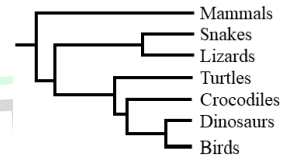
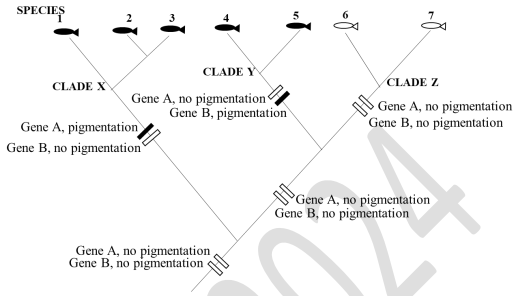
Given this tree topology, which one or more of the following statements is/are correct?A phylogenetic tree for the evolution of two pigmentation traits in species of fish is shown for clades X, Y and Z. Genes A and/or B, if mutated, can cause dark pigmentation in the body.
Which one or more of the following statements is/are correct?- Whales and dolphins are hypothesized to have evolved along the northern shore of the Tethys Sea, prior to the Indian plate's collision with the Eurasian plate. To which one of the following animals are these aquatic mammals most closely related?
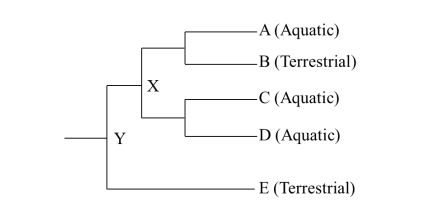
The phylogenetic tree depicts the relationship between 5 species of snakes(labelled A to E) and provides information about their habitat specialization. Given the principle of parsimony (least number of evolutionary changes required)and that ancestor Y was terrestrial, which one of the options given is correct?