
The following figure shows a refolded structure formed due to interference of an early fold ($\text{F}_1$) and a late fold ($\text{F}_2$). Which one of the following is the correct interpretation of observations at (a) and (b) in the figure?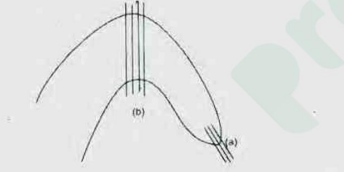
(b) $\text{F}_2$ fold and $\text{F}_2$ axial planar cleavage
The question involves understanding the interference of folds, specifically an early fold \( \text{F}_1 \) and a late fold \( \text{F}_2 \), and interpreting their axial planar cleavages in a refolded structure shown in the image.
Step-by-step Explanation:
- Understanding the Diagram:
- In the provided diagram, there are two main notations: (a) and (b).
- 'Folds' refer to bends in layered rocks, and 'axial planar cleavage' refers to planar features that develop parallel to the fold axes.
- Interpreting Point (a):
- At point (a), the structure appears to have more tightly spaced cleavage lines and a less pronounced fold.
- This indicates an original early fold (\( \text{F}_1 \)) because tighter cleavages typically associate with the original fold's deformational features.
- Interpreting Point (b):
- At point (b), the structure shows a more open fold with broader cleavage spacing.
- This corresponds to a later fold (\( \text{F}_2 \)) as it overprints and refolds the pre-existing structure, thus distorting the early fold's original spacing.
- Conclusion and Selection:
- For point (a), we identify an \( \text{F}_1 \) fold and \( \text{F}_1 \) axial planar cleavage.
- For point (b), the structure fits an \( \text{F}_2 \) fold and \( \text{F}_2 \) axial planar cleavage.
Correct Option:
(a) \( \text{F}_1 \) fold and \( \text{F}_1 \) axial planar cleavage
(b) \( \text{F}_2 \) fold and \( \text{F}_2 \) axial planar cleavage
Important Questions from Folds
The following figure shows the lower hemisphere, equal area plots of the poles to bedding surfaces. Which one of the following is the correct interpretation?
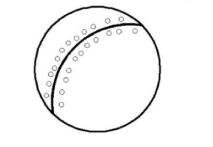
- The intersection of bedding surface with upright slaty cleavage surface occurs as horizontal lineation. Which one of the following is the most likely interpretation? The bedding surfaces are folded into
Figures A and B show two cross-sections of a folded sandstone bed.
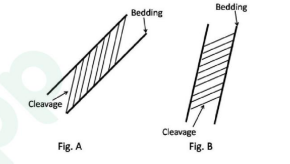
Which one of the following is the correct interpretation of the Figs. A and B?
Match the outcrop patterns of folds with corresponding types.
Outcrop Patterns Fold A. 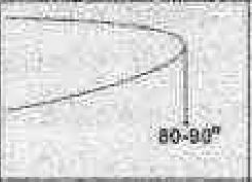
P. Plunging antiform B. 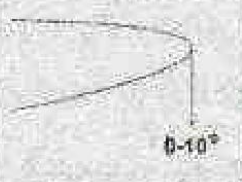
Q. Plunging synform C. 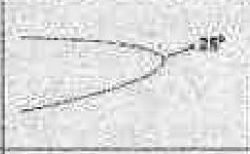
R. Reclined D. 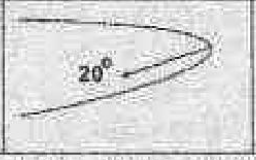
S. Recumbent - Which one of the following is the correct angle between the hinge line and the strike line of the axial plane in a reclined fold?


