
Bacterial Population Growth Calculation
This problem involves calculating the time required for a bacterial population to grow from an initial density to a final density, given its doubling time during exponential growth.
Identify Given Information
- Initial Density ($N_0$): 35 cells/ml
- Final Density ($N$): 560 cells/ml
- Doubling Time ($t_d$): 60 minutes
- Growth Phase: Exponential
- Resources: Unlimited
Growth Formula
The formula for exponential growth based on doubling time is:
$ N = N_0 \times 2^{(t/t_d)} $
Where:
- $N$ is the final population density.
- $N_0$ is the initial population density.
- $t$ is the time elapsed.
- $t_d$ is the doubling time.
Calculate Time (t)
- Determine the number of doublings: First, find the ratio of the final density to the initial density. $ \frac{N}{N_0} = \frac{560 \text{ cells/ml}}{35 \text{ cells/ml}} = 16 $ This ratio represents the factor by which the population has increased.
- Relate ratio to doublings: Since the population doubles each cycle, we need to find how many doublings result in a factor of 16. $ 2^x = 16 $ Where $x$ is the number of doublings. We know that $2^4 = 16$, so $x = 4$.
- Calculate total time: The population has doubled 4 times. Since each doubling takes 60 minutes: $ t = \text{Number of doublings} \times t_d $ $ t = 4 \times 60 \text{ minutes} $ $ t = 240 \text{ minutes} $
- Convert to hours: To express the time in hours, divide by 60. $ t (\text{hours}) = \frac{240 \text{ minutes}}{60 \text{ minutes/hour}} = 4 \text{ hours} $
Conclusion
The calculated time is exactly 4 hours. This value falls within the specified range of 3.9 to 4.1 hours, confirming the calculation.
Important Questions from Population growth curves
- A flask containing nutrient-rich media is seeded with 100 isogenic bacteria. Assuming that no bacteria die in the flask, after approximately how many generations will the population reach a size of $10^5$?
Population growth of a species can be modelled as $$ \frac{dN(t)}{dt} = rN(t)\left(1 - \frac{N(t)}{K}\right) $$ where $N(t)$ is the population size at time $t$; $r$ is the growth rate; and $K$ is the carrying capacity of the environment.
For $K = 9000$, $\frac{dN(t)}{dt}$ is maximized at $N =$ _____
(Answer in integer)
- The population size at which net recruitment is the highest is also when the greatest amount can be harvested, while ensuring the long-term survival of the population. The amount harvested at this population size is known as
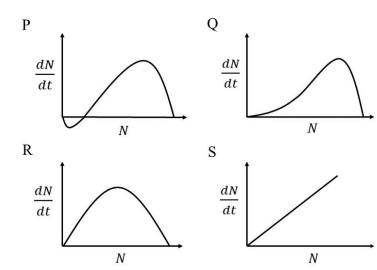
The graphs shown represent the relationship between population size ($N$) and population growth rate ($\frac{dN}{dt}$). Which one of the following growth curves represents a density-dependent population that experiences a strong Allee effect?
Overfishing reduced food availability for sea lions in California, causing a decline in their population size. In 1972, under the US Endangered Species Act, fishing was banned from sea lion foraging areas. Subsequently, the population of sea lions increased in a logistic form as shown in the figure.
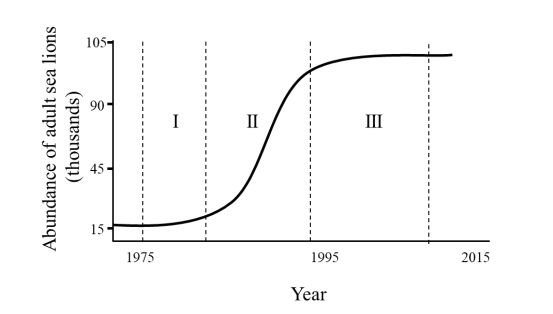
The per capita growth rate is highest in the interval __________ and the population growth rate is highest in the interval __________


