
The constitutional undercooling condition for a hypothetical binary alloy of A with solute B during solidification is shown in the figure along with its binary phase diagram. Based on these two schematics, one can conclude that the solute concentration in region X will be _______________ the average composition of the initial liquid phase.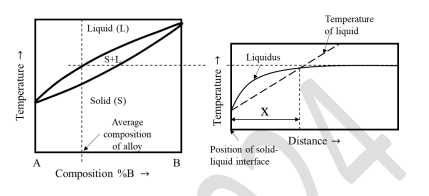
The question pertains to the concept of constitutional undercooling during the solidification of binary alloys. Understanding this requires a grasp of phase diagrams and how solute distribution occurs at the solid-liquid interface during cooling.
In a binary alloy, as solidification begins, the solid phase that forms has a composition different from the liquid phase. This is because the solute is generally rejected by the forming solid and accumulates in the liquid ahead of the solidification front. This leads to a gradient in solute concentration, which causes constitutional undercooling.
- Considering the phase diagram given, the liquid and solid phases have different compositions. The solid phase usually rejects the solute, meaning the composition of the solid is lower in solute B than the liquid.
- The region "X" in the schematic represents a point in the liquid ahead of the solidification front where the temperature is below the liquidus temperature due to the high solute concentration. In this region, the concentration of solute B is greater than the average composition of the liquid.
- The constitutional undercooling condition causes solute concentration in the liquid near the interface to be higher than in the bulk liquid.
Therefore, in region "X," the solute concentration is less than the average composition of the initial liquid phase because the solute is rejected by the solid and accumulates in the adjacent liquid.
Thus, the correct answer is less than.
Important Questions from Solidification Directional Solidification
A hypothetical binary eutectic phase diagram of A – B is shown below. An alloy with 5 wt.% B solidifies with no convection. Assuming steady state, the critical temperature gradient (in K $mm^{-1}$) required to maintain planar solidification front is: ________ (round off to nearest integer).
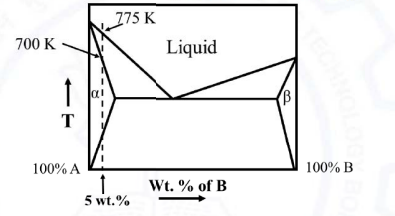
Given:
Diffusivity of B in liquid = $10^{-9}$ $m^2$ $s^{-1}$
Velocity of solidification front = 4 $\mu m$ $s^{-1}$For a solid embryo in contact with a perfectly flat mould wall as shown in the schematic, the wetting angle $\theta$ is __________ degrees.
(Round off to one decimal place).
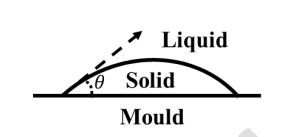
Given:
Surface tension between liquid and mould wall = $0.35 \text{ J.m}^{-2}$
Surface tension between solid and mould wall = $0.02 \text{ J.m}^{-2}$
Surface tension between liquid and solid = $0.40 \text{ J.m}^{-2}$
In continuous casting of steel, mould flux is used for ______________
The critical radius (in $nm$, rounded off to one decimal place) of nickel nucleus during solidification at $1673 \text{ K}$ is ________.
Given: Enthalpy of fusion of nickel = $2.65 \times 10^9 \text{ J.m}^{-3}$;
Liquid-solid interfacial energy = $0.5 \text{ J.m}^{-2}$, and
Equilibrium melting temperature of nickel = $1728 \text{ K}$.
Single crystal turbine blades of nickel-based superalloys for aero-engines are manufactured using:


