
In continuous casting of steel, mould flux is used for ______________
Continuous Casting: Mould Flux Functions
Mould flux plays a critical role in the continuous casting process of steel. It is a specifically designed mixture that melts on the surface of the molten steel in the mould.
Key Roles of Mould Flux
The primary functions addressed by mould flux in continuous casting include:
-
Lubrication: Mould flux provides essential lubrication between the solidifying steel shell and the copper mould wall. This prevents the steel from sticking to the mould, allowing for smooth withdrawal and preventing surface defects.
-
Reducing Heat Loss: The molten slag layer acts as an insulating barrier on the molten steel surface. This helps in reducing heat loss from the steel pool, maintaining temperature consistency, and promoting stable solidification.
-
Inclusion Control: Mould flux helps manage non-metallic inclusions. It traps impurities and oxides present in the molten steel, allowing them to float to the surface and be absorbed by the slag layer, rather than being incorporated into the solid steel strand.
These functions are vital for producing high-quality steel continuously.
Important Questions from Solidification Directional Solidification
A hypothetical binary eutectic phase diagram of A – B is shown below. An alloy with 5 wt.% B solidifies with no convection. Assuming steady state, the critical temperature gradient (in K $mm^{-1}$) required to maintain planar solidification front is: ________ (round off to nearest integer).
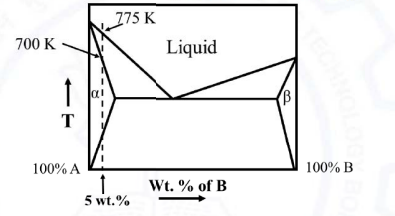
Given:
Diffusivity of B in liquid = $10^{-9}$ $m^2$ $s^{-1}$
Velocity of solidification front = 4 $\mu m$ $s^{-1}$For a solid embryo in contact with a perfectly flat mould wall as shown in the schematic, the wetting angle $\theta$ is __________ degrees.
(Round off to one decimal place).
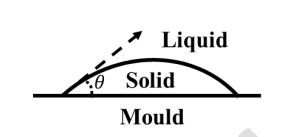
Given:
Surface tension between liquid and mould wall = $0.35 \text{ J.m}^{-2}$
Surface tension between solid and mould wall = $0.02 \text{ J.m}^{-2}$
Surface tension between liquid and solid = $0.40 \text{ J.m}^{-2}$
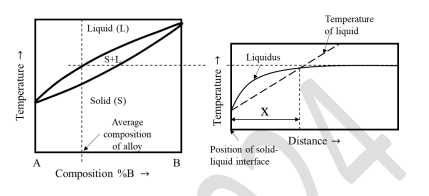
The constitutional undercooling condition for a hypothetical binary alloy of A with solute B during solidification is shown in the figure along with its binary phase diagram. Based on these two schematics, one can conclude that the solute concentration in region X will be _______________ the average composition of the initial liquid phase.
The critical radius (in $nm$, rounded off to one decimal place) of nickel nucleus during solidification at $1673 \text{ K}$ is ________.
Given: Enthalpy of fusion of nickel = $2.65 \times 10^9 \text{ J.m}^{-3}$;
Liquid-solid interfacial energy = $0.5 \text{ J.m}^{-2}$, and
Equilibrium melting temperature of nickel = $1728 \text{ K}$.
Single crystal turbine blades of nickel-based superalloys for aero-engines are manufactured using:


