
Single crystal turbine blades of nickel-based superalloys for aero-engines are manufactured using:
Manufacturing Single Crystal Turbine Blades
Single crystal turbine blades are crucial components in aero-engines, especially those made from nickel-based superalloys. Their design aims to maximize performance at extremely high temperatures and under significant stress.
Key Manufacturing Process
The most effective method for producing these specialized blades is Directional Solidification. This process is specifically designed to control the grain structure of the metal during cooling.
- Goal: To eliminate grain boundaries, which are typically weak points, especially at high operating temperatures. A single crystal structure prevents creep deformation and fatigue failure associated with grain boundaries.
- Method: Directional solidification involves carefully controlling the melting and cooling process, often starting from a seed crystal, to ensure that the metal solidifies as a single, continuous crystal aligned with the blade's stress axis.
Comparison with Other Methods
Other casting techniques are generally less suitable for producing single-crystal turbine blades:
- Investment Casting: While capable of producing complex shapes like turbine blades and often used as a base process, standard investment casting results in a polycrystalline (many-grained) structure. Achieving single crystals requires modifications like those used in directional solidification, making it a specific variant rather than a distinct alternative method for SC blades.
- Die Casting: This high-speed process is unsuitable for the high-temperature nickel-based superalloys and the precise crystallographic control needed for single-crystal blades.
- Squeeze Casting: This method combines casting with high pressure, improving density and mechanical properties but is not inherently designed for growing single crystals.
Therefore, directional solidification is the technique specifically employed to achieve the required single-crystal structure in advanced turbine blades.
Important Questions from Solidification Directional Solidification
A hypothetical binary eutectic phase diagram of A – B is shown below. An alloy with 5 wt.% B solidifies with no convection. Assuming steady state, the critical temperature gradient (in K $mm^{-1}$) required to maintain planar solidification front is: ________ (round off to nearest integer).
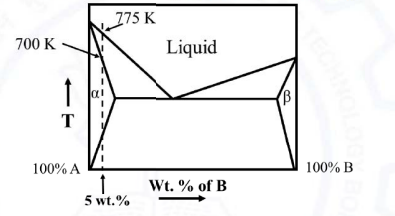
Given:
Diffusivity of B in liquid = $10^{-9}$ $m^2$ $s^{-1}$
Velocity of solidification front = 4 $\mu m$ $s^{-1}$For a solid embryo in contact with a perfectly flat mould wall as shown in the schematic, the wetting angle $\theta$ is __________ degrees.
(Round off to one decimal place).
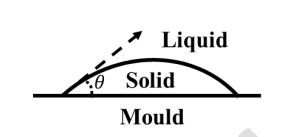
Given:
Surface tension between liquid and mould wall = $0.35 \text{ J.m}^{-2}$
Surface tension between solid and mould wall = $0.02 \text{ J.m}^{-2}$
Surface tension between liquid and solid = $0.40 \text{ J.m}^{-2}$
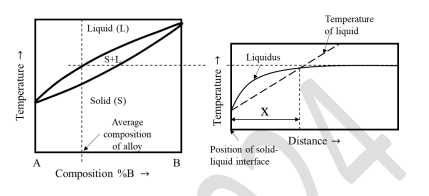
The constitutional undercooling condition for a hypothetical binary alloy of A with solute B during solidification is shown in the figure along with its binary phase diagram. Based on these two schematics, one can conclude that the solute concentration in region X will be _______________ the average composition of the initial liquid phase.
In continuous casting of steel, mould flux is used for ______________
The critical radius (in $nm$, rounded off to one decimal place) of nickel nucleus during solidification at $1673 \text{ K}$ is ________.
Given: Enthalpy of fusion of nickel = $2.65 \times 10^9 \text{ J.m}^{-3}$;
Liquid-solid interfacial energy = $0.5 \text{ J.m}^{-2}$, and
Equilibrium melting temperature of nickel = $1728 \text{ K}$.


