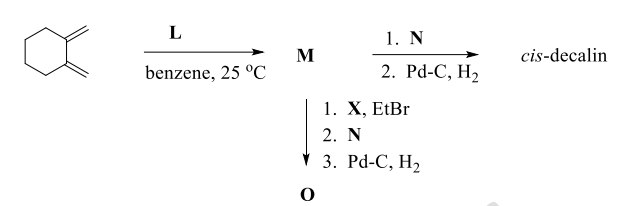
Identify Compound [X] using Spectral Data
The problem asks us to identify compound [X], a monobromo ketone with molecular formula C$_5$H$_9$BrO, based on its $^1$H and $^{13}$C NMR data.
Structure Elucidation using NMR Data
Analyze the given spectral data for compound [X]:
- Molecular Formula: C$_5$H$_9$BrO. This indicates one degree of unsaturation (likely the C=O group).
- $^{13}$C NMR: $\delta$ 17, 37, 39, 210.
- The signal at $\delta$ 210 ppm is characteristic of a ketone carbonyl carbon (C=O).
- The signal at $\delta$ 17 ppm suggests methyl carbons (CH$_3$).
- Signals at $\delta$ 37 and 39 ppm suggest aliphatic carbons (CH or CH$_2$).
- The presence of 4 signals suggests some symmetry or overlap.
- $^1$H NMR:
- $\delta$ 1.17 (d, 6H): Indicates two equivalent methyl groups attached to a CH group, forming an isopropyl fragment ((CH$_3$)$_2$CH-).
- $\delta$ 3.02 (m, 1H): Corresponds to the CH proton of the isopropyl group, adjacent to the carbonyl group.
- $\delta$ 4.10 (s, 2H): Indicates two equivalent protons on a CH$_2$ group, adjacent to an electronegative atom (like Br) and/or the carbonyl group, and not adjacent to any other protons (hence the singlet).
Proposing the Structure of [X]
Combining the NMR data and the molecular formula:
- The presence of (CH$_3$)$_2$CH- (3H + 1H = 4H) and a C=O group accounts for C$_3$H$_7$O.
- The singlet at $\delta$ 4.10 (2H) suggests a -CH$_2$- group.
- The formula requires C$_5$H$_9$BrO. We have accounted for C$_4$H$_9$O. We need one more carbon and one bromine.
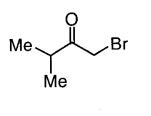
- The structure must be BrCH$_2$-CO-CH(CH$_3$)$_2$. Let's verify this structure.
- Formula: C$_5$H$_9$BrO. Correct.
- $^{13}$C NMR: C=O (210 ppm), CH$_3$ (17 ppm, two equivalent carbons), CH (37-39 ppm), CH$_2$Br (37-39 ppm). Fits the observed 4 signals (CH and CH$_2$Br likely overlap or are very close).
- $^1$H NMR:
- (CH$_3$)$_2$CH-: Doublet (6H) at 1.17 ppm, Multiplet (1H) at 3.02 ppm. Matches.
- BrCH$_2$-CO-: Singlet (2H) at 4.10 ppm. Matches.
- This structure corresponds to option 4.
Conclusion
The spectral data perfectly matches the structure 1-bromo-3-methylbutan-2-one (BrCH$_2$-CO-CH(CH$_3$)$_2$), which is represented by option 4.
Important Questions from Organic Synthesis
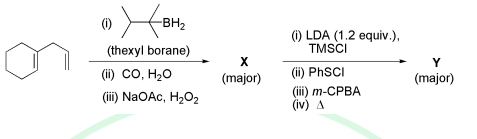
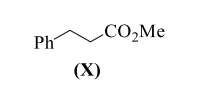
The major products X and Y formed in the following reaction sequences are
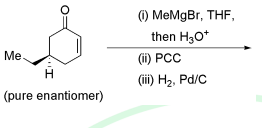
For the following reaction, the possible product(s) is/are
The reaction(s) that yield(s) X as the major product is (are)
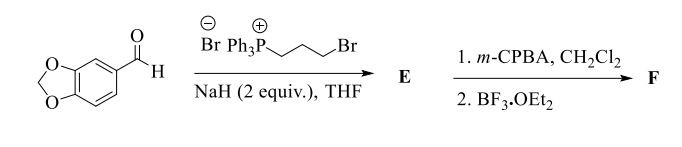
The major products E and F in the following reaction sequence are
Consider the following reaction sequence. The correct option(s) is (are)