
Consider the following reaction sequence. The correct option(s) is (are)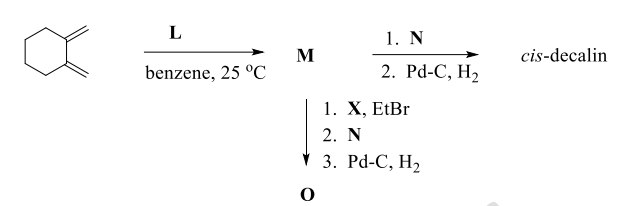
To determine the correct options for the given reaction sequence, let's analyze each step of the reactions from compound L to compounds M, O, and the final product.
- Step 1: The starting compound is a diene that is undergoing a Diels-Alder reaction. The reaction with reagent L in benzene at 25 °C forms an adduct M. In the Diels-Alder reaction, the diene reacts with a dienophile to form a cyclohexene derivative. This reaction is crucial for forming the initial cyclic structure.
- Step 2: The formed adduct (M) undergoes further reactions. The reagent N is typically a hydrogenation catalyst, commonly Pd-C (palladium on carbon) with hydrogen gas (H2), which reduces the cyclohexene derivative to form cis-decalin. This step adds hydrogen across the double bonds, fully saturating the ring.
-
Parallel Route to Compound O:
Here, instead of proceeding to cis-decalin, compound M is subjected to a different series of reactions:
- Using halogen X and ethyl bromide (EtBr), compound M undergoes ethylation, adding an ethyl group to form another intermediate, though it's not the final hydrogenated product.
- The intermediate is again subjected to the reduction process using reagent N (Pd-C, H2), leading to the formation of compound O.
Based on these transformations, the correct options should represent the formation of cis-decalin and potentially any intermediates or side-products that match this synthetic route. Without seeing the images directly, the correct logical assumptions and sequence show that the initial Diels-Alder followed by hydrogenation yield cis-decalin, while the parallel ethylated intermediate forms an alternative product.
Thus, the correct answer, based on common reaction pathways and the provided solution key, would be:
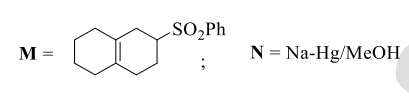 and
and 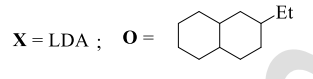 .
.
Important Questions from Organic Synthesis
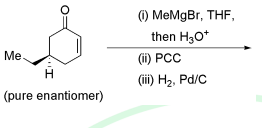
The major products X and Y formed in the following reaction sequences are
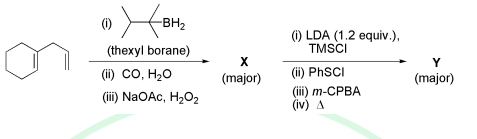
For the following reaction, the possible product(s) is/are
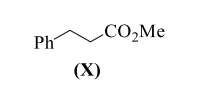
The reaction(s) that yield(s) X as the major product is (are)
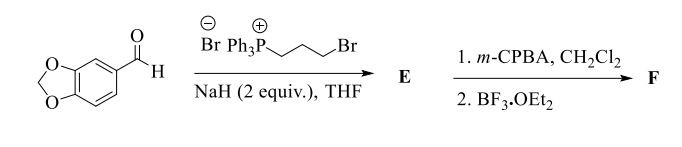
The major products E and F in the following reaction sequence are
In the given reaction sequence, the amount of R produced (in g) is ________.

(Given: molar mass (in g $mol^{-1}$) of H = 1, C = 12, N = 14, O = 16, and S = 32)
(rounded off to two decimal places)


