
Understanding $B_2H_6$ Structure
Diborane, $B_2H_6$, exists as a dimer. Its structure features two boron atoms, each bonded to two terminal hydrogen atoms. The molecule is held together by two bridging hydrogen atoms, each forming a 3-center-2-electron bond (also known as a banana bond) with the two boron atoms.
Comparing $Al_2Cl_6$ Structure
Aluminum chloride ($AlCl_3$) typically exists as a dimer, $Al_2Cl_6$, particularly in the solid state and at lower temperatures in the gas phase. This dimer adopts a structure analogous to diborane.
- Two aluminum atoms are present.
- Two chlorine atoms act as bridges between the two aluminum atoms, forming Al-Cl-Al bridges similar to the B-H-B bridges in $B_2H_6$.
- Each aluminum atom is also bonded to two terminal chlorine atoms.
- This structure also involves 3-center-2-electron bonds.
Structural Comparison
The dimeric structure of $Al_2Cl_6$, with its bridging halogen atoms and similar bonding pattern (3-center-2-electron bonds), makes it structurally similar to $B_2H_6$. Both compounds exhibit this characteristic dimeric bridged structure due to the electron deficiency of the central atoms (Boron and Aluminum).
Analysis of Other Options
- $Si_2Cl_6$: This molecule has a structure analogous to ethane ($C_2H_6$), featuring a direct Si-Si single bond, with each silicon atom bonded to three chlorine atoms. It does not possess the bridged structure characteristic of $B_2H_6$.
- $I_2Cl_6$: While the dimer of $ICl_3$, $I_2Cl_6$, also features bridging chlorine atoms and is sometimes considered analogous, $Al_2Cl_6$ is the more commonly cited and direct structural analogue to $B_2H_6$ in introductory contexts, particularly emphasizing Lewis acid dimerization.
- $Cl_2O_6$: This compound typically exists as ionic species or has a different bonding arrangement not resembling diborane.
Conclusion
Based on the characteristic dimeric structure with bridging atoms and 3-center-2-electron bonds, $Al_2Cl_6$ is structurally similar to $B_2H_6$.
Important Questions from Boranes
The structure of $B_4H_{10}$ is given below. Its styx number is
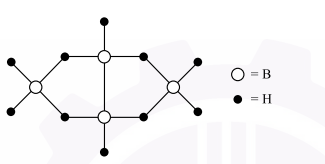
- Among the given boranes and heteroboranes, the example which belongs to 'closo' type is
- An example of nido-borane from the following is
- $BCl_3$ and $NH_4Cl$ were heated at $140$ $°C$ to give compound X, which when treated with $NaBH_4$ gave another compound Y. Compounds X and Y are


