
Boron Nitride Compound Synthesis Explained
This solution details the chemical synthesis pathway to identify compounds X and Y based on the provided reactions.
Synthesis of Compound X ($B_3N_3H_3Cl_3$)
The reaction involves heating boron trichloride ($BCl_3$) with ammonium chloride ($NH_4Cl$) at $140$ $°C$. This process leads to the formation of a cyclic boron-nitrogen compound, specifically a substituted borazine.
The balanced chemical equation representing this step is approximately:
$3 BCl_3 + 3 NH_4Cl \xrightarrow{140°C} B_3N_3H_3Cl_3 + 6 HCl$
Therefore, compound X is identified as $B_3N_3H_3Cl_3$ (chloroborazine).
Reduction to Compound Y ($B_3N_3H_6$)
Compound X ($B_3N_3H_3Cl_3$) is subsequently treated with sodium borohydride ($NaBH_4$). $NaBH_4$ acts as a reducing agent, replacing the chlorine atoms bonded to boron with hydrogen atoms.
The reaction substitutes the three chlorine atoms in X with hydrogen atoms, yielding a fully hydrogenated borazine ring:
$B_3N_3H_3Cl_3 + 3 NaBH_4 \rightarrow B_3N_3H_6 + \text{byproducts}$
Thus, compound Y is identified as $B_3N_3H_6$ (borazine).
Identifying the Correct Option
Based on the synthesis steps:
- Compound X = $B_3N_3H_3Cl_3$
- Compound Y = $B_3N_3H_6$
Comparing these results with the given options, Option 1 correctly identifies both compounds X and Y.
Important Questions from Boranes
The structure of $B_4H_{10}$ is given below. Its styx number is
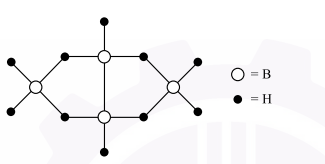
- The compound(s) having structure similar to that of $B_2H_6$ is/are
- Among the given boranes and heteroboranes, the example which belongs to 'closo' type is
- An example of nido-borane from the following is


