
The circuit below shows an up/down counter working with a decoder and a flip-flop. Preset and Clear of the flip-flop are asynchronous active-low inputs. Assuming that the initial value of counter output ($Q_2 Q_1 Q_0$) as zero, the counter outputs in decimal for 12 clock cycles are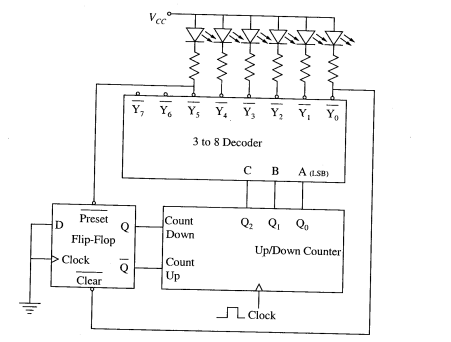
Let's solve the given problem by analyzing the circuit configuration. The given circuit includes an up/down counter along with a decoder and a flip-flop.
- The counter used is a 3-bit up/down counter, with outputs labeled as Q_2 Q_1 Q_0.
- The flip-flop controls the mode of the counter (up or down) using its output Q. The flip-flop is controlled by a clock signal and has asynchronous preset and clear inputs.
- Initially, the counter starts at zero: Q_2 Q_1 Q_0 = 000.
- The counter needs to count the following sequence based on the position of the flip-flop:
We analyze the sequence over 12 clock cycles as follows:
- Clock Cycles 1-5 (Count Up): The counter will increment by one at each clock cycle. Thus, the sequence will be:
0, 1, 2, 3, 4, 5
- Clock Cycles 6-11 (Count Down): After reaching the maximum (5), the flip-flop presumably toggles to the "count down" mode:
5, 4, 3, 2, 1, 0
- Clock Cycle 12 (Count Up Again): The counter begins counting up again:
0, 1
- The sequence restarts, resulting in the full cycle as follows: 0, 1, 2, 3, 4, 5, 4, 3, 2, 1, 0, 1, 2.
The correct answer is therefore: 0, 1, 2, 3, 4, 5, 4, 3, 2, 1, 0, 1, 2.
Important Questions from Sequential Circuits
The design of synchronous circuit involves following steps
A. From the specifications, derive a state diagram of a circuit
B. Derive the simplified flip-flops input and output equations.
C. Reduce the number of state, if necessary
D. Choose the type of flip-flops to be used
E. Assign binary values to the states and obtain binary coded table
Choose the correct answer from the options given below:
- Find the time periods ($T_{ON}$ and $T_{OFF}$) of an astable multivibrators that oscillates at 50 kHz and 60% duty cycle.
In the procedural statement, reset action occurs if ____________
always @ (negedge clock) begin
if (! Reset) D=0; else Q=D
end
Read the following statements :
i. Gate is a combinational logic.
ii. JK Flip-flop in toggle mode is not combinational logic.
iii. MSJK FF suffers from race-around.
iv. Counters are sequential circuits.Which is correct ?
Which flip-flop can be used as latch ?


