
The assembly shown below has three teethed circular objects (Pinions) and two teethed flat objects (Racks), which are perfectly mating with each other. Pinions can only rotate clockwise or anti-clockwise staying at its own center. Racks can translate towards the left (←) or the right (→) direction. If the object A (Rack) is translating towards the right (→) direction, the correct statement among the following is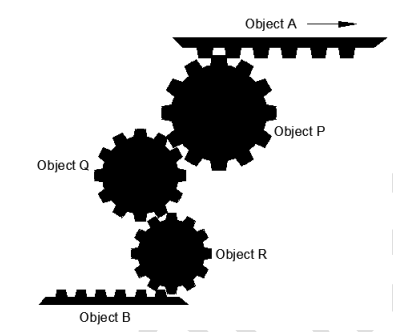
To solve this problem, we need to understand the mechanics of how the pinions (circular objects) and racks (flat objects) interact when movement occurs. The question involves a gear train system with the following components:
- Observation: Object A is a rack moving towards the right (→). This movement will cause the pinion it is engaged with (Object P) to rotate.
- Direction of Rotation: As Object A moves to the right, Object P will rotate clockwise because they are in direct contact, and racks translate the rotational movement into linear and vice versa.
- Effect on Adjacent Pinions: Object P, rotating clockwise, will drive Object Q. Due to gearing, Object Q will rotate in the opposite direction, which is anti-clockwise.
- Effect on Object R: Since Object Q is rotating anti-clockwise, it will cause Object R to rotate clockwise (adjacent pinions move in opposite directions).
- Effect on Rack B: Object R, rotating clockwise, will drive Rack B. As racks and pinions translate rotational movement into linear, the rack will move opposite to the rotation of the pinion. Therefore, Rack B will move towards the left (←).
Conclusion: Based on the chain of interactions, the correct statement is that Object B translates towards the left direction. This is supported by the mechanics of the gear system where adjacent pinions rotate in opposite directions, and the linear movement of racks is determined by the rotation of the pinions they engage with.
Important Questions from Reasoning
Some even numbers such as 6, 8, 24, 28, 32 and 46 are given. If you ask your students to sum any two even numbers given, then in each case they will get an even number. Therefore, by studying the various uses of this type, we can conclude that the sum of any two even numbers is always even. What kind of logic do we observe from the above statement?
I. Inductive reasoning
II. Deductive Reasoning
Match the following approaches of moral reasoning with their propounders:
Choose the correct option from the following:Moral Reasoning Proponder(s) (a) Consequentialism Approach (i) Thomas Hobbes, Ayow Rand (b) Deontological Approach (ii) Aristotle (c) Natural law theory (iii) Ronald F. White (d) Theological Approach (iv) W.D. Ross, John Rawls Four words have been given, out of which three are alike in some manner and one is different. Select the one that is different.
Find the wrong number in the given series.
4, 8, 16, 24, 40, 62, 104, 168, 296
Ramesh went 15 m to the east, then he turned left and after \(5\sqrt 3 \) m turned 120° right and went \(10\sqrt 3 \) m and then turned 120° right and went \(20\sqrt 3 \) m. How far was Ramesh from the starting point ?


