
Testing SARS-CoV-2 Transmission Hypothesis
To investigate the proposed SARS-CoV-2 transmission route (bats → pangolins → humans), methods that analyze evolutionary relationships and genetic similarities between viruses and hosts are required.
Evaluating Testing Methods
- Comparative Genomics: This method involves comparing the genome sequences of SARS-CoV-2 isolates from different hosts (bats, pangolins, humans) and related viruses. It helps identify genetic similarities, mutations, and evolutionary links, making it highly effective for tracing the virus's origin and spread between species.
- Phylogenetics: Phylogenetics reconstructs the evolutionary history and relationships among organisms or viruses. By building phylogenetic trees using genetic data from SARS-CoV-2 found in bats, pangolins, and humans, scientists can infer the direction of transmission and identify the closest relatives, supporting or refuting the hypothesis.
- DNA Fingerprinting: This technique is typically used for identifying individuals or determining genetic relationships between individuals within a species. It is not suitable for tracing the cross-species transmission history of a virus like SARS-CoV-2.
- Transgenesis: Transgenesis involves modifying an organism's genome by introducing external DNA. This technique is unrelated to studying the natural transmission pathways of viruses between different species.
Therefore, Comparative genomics and Phylogenetics are the most effective methods for testing the hypothesis.
Important Questions from Phylogenetic trees
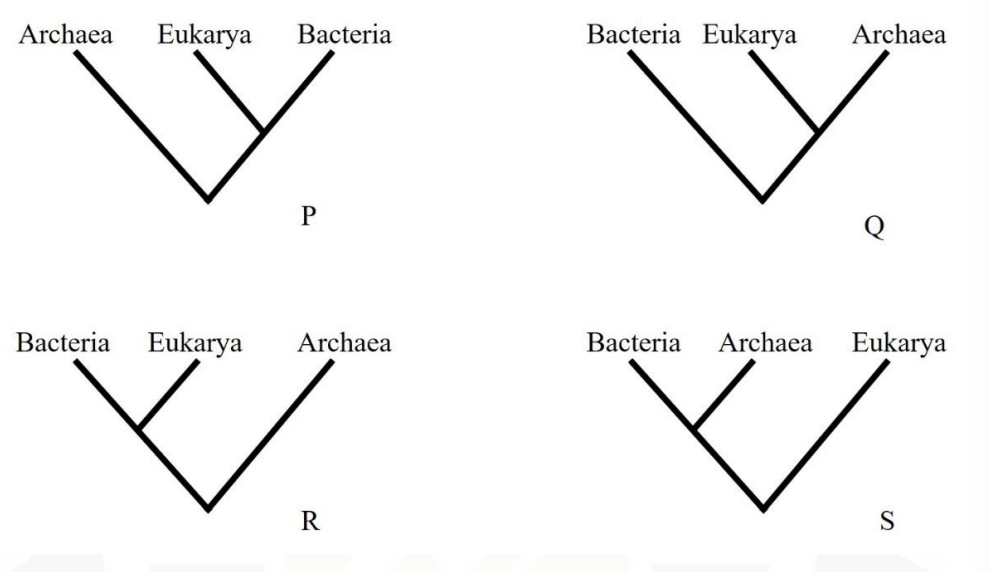
Which one of the following phylogenetic trees illustrates the relationship between Archaea, Bacteria and Eukarya?
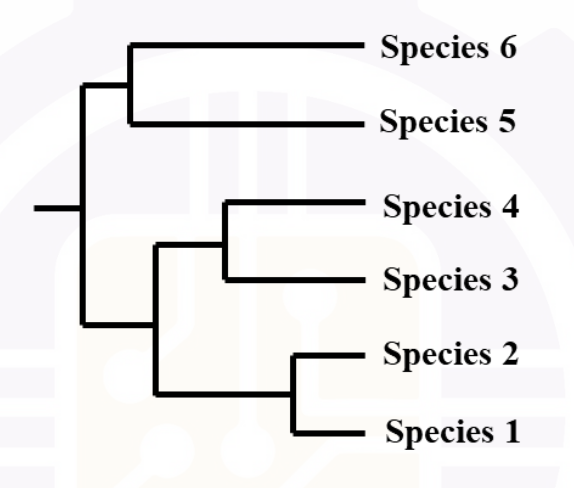
The phylogeny of six species of birds is illustrated below, where the horizontal branch lengths correspond to genetic distance. These six species are distributed in three islands X, Y, and Z. Island X harbours species 1, 4, 6; Island Y harbours species 1, 2, 4; and Island Z harbours species 3, 4, 5. Which one of the following is true about the phylogenetic diversity of these islands?
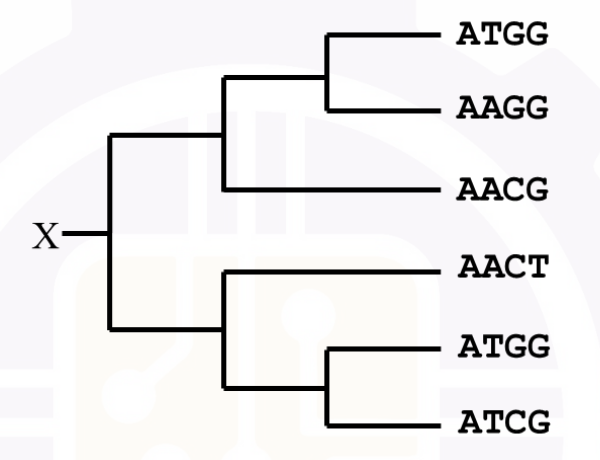
The phylogeny below shows the relationship between six species based on whole genome data. The sequence of a part of a particular gene from each species is provided at the tips of the tree. Based on the principle of parsimony, which one of the following is the expected sequence for the ancestor X?
A phylogenetic tree for the evolution of two pigmentation traits in species of fish is shown for clades X, Y and Z. Genes A and/or B, if mutated, can cause dark pigmentation in the body.
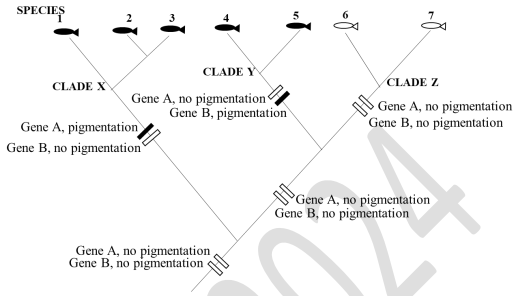
Which one or more of the following statements is/are correct?- Which of the following trees is phylogenetically MOST accurate?


