
Refer to the following series and answer the question. (Counting to be done from left to right only.) (all numbers are single digit numbers only.) (Left) 9 2 3 1 4 5 6 8 5 4 3 2 1 9 3 4 5 6 7 8 1 2 9 8 3 4 5 2 6 8 2 (Right) How many such even digits are there, each of which is immediately preceded by a perfect square and immediately followed by an odd digit? (NOTE: 1 is also a perfect square.)
More than three
The single-digit perfect squares available here are 1, 4 and 9. We scan the series for each even digit and check that the digit just before it is one of these squares and the digit just after it is odd.
Series: 9 2 3 1 4 5 6 8 5 4 3 2 1 9 3 4 5 6 7 8 1 2 9 8 3 4 5 2 6 8 2
The pattern is (perfect square)(even)(odd). Checking position by position gives the matches: 9 2 3 (9 is a square, 3 is odd) ✓; 1 4 5 (1 is a square, 5 is odd) ✓; 1 2 9 (1 is a square, 9 is odd) ✓; 9 8 3 (9 is a square, 3 is odd) ✓.
No other even digit satisfies both conditions, so exactly 4 such even digits are found.
Since 4 is greater than three, the required count is best described as "More than three".
Similar Questions
Select the number from among the given options that will come next in the following series.
$20, 40, 63, 90, 122,$ _____
- In the following triads, each group of letters is related to the subsequent one following a certain logic. Select from the given options, the one which follows the same logic.
LUNG - UNLG - GNUL
FERN - ERFN - NREF - What should come in place of the question mark (?) in the given series based on the English alphabetical order?
RXY TTV ? XLP ZHM - In the following triads, each group of letters is related to the subsequent one following a certain logic. Select from the given options, the one which follows the same logic.
POST - OPST - PSTO
LITE - ILTE - LTEI - Which of the following letter-number clusters will replace the question mark (?) in the given series to make it logically complete?
DKR 79, HOV 73, LSZ 67, PWD 61, TAH 55, ? - Identify the term that does NOT belong to the following series.
A5, F11, K24, P51, T105, Z217 - Identify the term that does NOT belong to the following series.
2T3, 5S6, 11R9, 16Q12, 23P15 - Without assuming anything beyond the information given, select the correct nature of relationship between the two events A and B. Event A: The teacher gave Zara severe punishment. Event B: Zara's parents have spoilt her.
- Identify the series that is different from the rest.
- Select the term that does NOT belong to the following series.
3DT, 7GS, 11PS, 15MQ, 19PP
Important Questions from Series
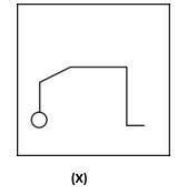
Select the option figure in which the given figure (X) is embedded (rotation is NOT allowed).
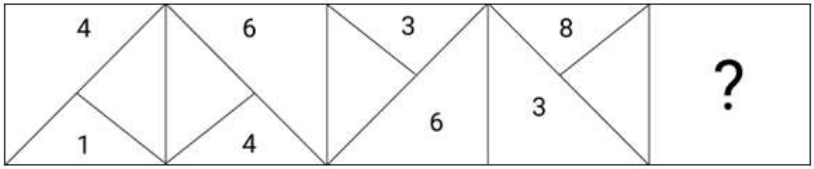
Identify the figure given in the options which when put in place of ? will logically complete the series.
When is a series of terms said to be in the order of increasing extension?
(A) When each term in the series (except the first) denotes a class having more members than a class denoted by the term preceding it.
(B) When the class size gets larger with each successive term.
(C) When each term in the series (except the first) denotes a class having fewer members than the class denoted by the term preceding it.
(D) When the class size gets smaller with each successive term
Choose the most appropriate answer from the options given below :
In the following question, select the missing number from the given series.
5, 10, 17, 26, 37, ?, 65
In the following question, select the missing number from the given series.
5, 10, 17, 26, 37, ?, 65



