When is a series of terms said to be in the order of increasing extension? (A) When each term in the series (except the first) denotes a class having more members than a class denoted by the term preceding it. (B) When the class size gets larger with each successive term. (C) When each term in the series (except the first) denotes a class having fewer members than the class denoted by the term preceding it. (D) When the class size gets smaller with each successive term Choose the most appropriate answer from the options given below :
Only (A) and (B) are correct
Understanding the concept of 'extension' in logic is key to answering this question. The extension of a term refers to the collection or class of all objects to which that term correctly applies. When we talk about a series of terms being in the order of increasing extension, it means that as we move from one term to the next in the sequence, the class of objects denoted by the term gets larger.
Defining Increasing Extension
Let's break down the definition of increasing extension:
- A series of terms is in increasing order of extension if the set of things each term refers to is larger than the set of things referred to by the term immediately before it (except for the very first term).
- Think of it like expanding circles. A term like "dog" refers to a certain group of animals. A term like "mammal" refers to a larger group that includes dogs, cats, humans, etc. A term like "animal" refers to an even larger group including all mammals, birds, fish, insects, etc. The series "dog", "mammal", "animal" is in the order of increasing extension because the class size gets progressively larger.
Analyzing the Given Statements
Now let's look at the statements provided in the options:
- Statement (A): "When each term in the series (except the first) denotes a class having more members than a class denoted by the term preceding it." This statement directly matches our understanding of increasing extension. If a class has "more members" than the preceding one, its size is larger, which is the definition of increasing extension.
- Statement (B): "When the class size gets larger with each successive term." This statement is another way of saying exactly what increasing extension means. The class size, which refers to the number of members in the class denoted by the term (its extension), is increasing term by term.
- Statement (C): "When each term in the series (except the first) denotes a class having fewer members than the class denoted by the term preceding it." This statement describes the opposite of increasing extension. If a class has "fewer members" than the preceding one, its size is smaller. This describes decreasing extension (or increasing intension).
- Statement (D): "When the class size gets smaller with each successive term." Similar to statement (C), this describes a decrease in the size of the class with each term. This represents decreasing extension.
Identifying Correct Statements for Increasing Extension
Based on our analysis:
- Statements (A) and (B) accurately describe the concept of a series of terms being in the order of increasing extension.
- Statements (C) and (D) describe the order of decreasing extension.
Therefore, the statements that correctly define a series of terms in the order of increasing extension are (A) and (B).
Looking at the provided options, we need to find the one that states only (A) and (B) are correct.
| Option | Statements Claimed Correct | Evaluation |
| 1 | Only (A) and (B) are correct | Correct. Both (A) and (B) define increasing extension. |
| 2 | Only (B) and (D) are correct | Incorrect. (D) describes decreasing extension. |
| 3 | Only (C) and (D) are correct | Incorrect. Both (C) and (D) describe decreasing extension. |
| 4 | Only (A) and (D) are correct | Incorrect. (D) describes decreasing extension. |
The option that correctly identifies only statements (A) and (B) as correct is Option 1.
Revision Table: Extension in Logic
| Concept | Description | Example Series (Increasing Extension) |
|---|---|---|
| Extension of a Term | The set of all objects to which the term applies. | - |
| Increasing Extension | A series where the extension (class size) of each successive term is larger than the previous one. | "Rose", "Flower", "Plant" |
| Decreasing Extension | A series where the extension (class size) of each successive term is smaller than the previous one. | "Animal", "Mammal", "Dog" |
| Intension of a Term | The set of attributes or properties that define the term. (Often inversely related to extension). | - |
Additional Information: Intension vs. Extension
In logic, the concept of extension is often discussed alongside 'intension'.
- Intension: This refers to the set of attributes or qualities that a term connotes or implies. For example, the intension of "dog" might include "mammal," "canine," "domesticated," "barks," etc.
- Relationship: Generally, there is an inverse relationship between intension and extension. As the intension of a term increases (more specific attributes are added), its extension typically decreases (fewer objects fit the description). Conversely, as the intension decreases (attributes are removed, making it more general), the extension increases (more objects fit the description).
- Example:
- Term: "Golden Retriever" - High intension (many specific attributes), Low extension (specific type of dog).
- Term: "Dog" - Lower intension than "Golden Retriever", Higher extension (all dogs).
- Term: "Mammal" - Lower intension than "Dog", Higher extension (all mammals).
Important Questions from Series
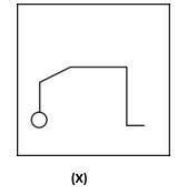
Select the option figure in which the given figure (X) is embedded (rotation is NOT allowed).
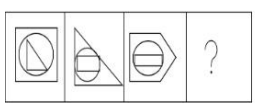
Identify the figure given in the options which when put in place of ? will logically complete the series.
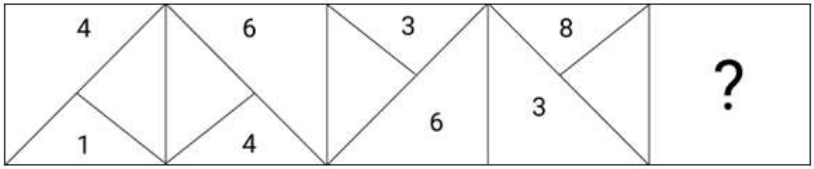
In the following question, select the missing number from the given series.
5, 10, 17, 26, 37, ?, 65
In the following question, select the missing number from the given series.
5, 10, 17, 26, 37, ?, 65
Identify the figure that best fits in place of the question mark.