A simply supported beam has a span of 6 m with an overhang of 4 m. A uniformly distributed load (UDL) of 6 kN/m acts over the overhang length of 4 m. What is the reaction at the nearest support?
32 kN
To find the reaction at the nearest support of a simply supported beam with an overhang, follow these steps:
Given:
- Span of simply supported beam, \(L = 6\, \text{m}\)
- Overhang length, \(L_{\text{overhang}} = 4\, \text{m}\)
- Uniformly Distributed Load (UDL) on overhang = \(6\, \text{kN/m}\)
Steps to solve:
- Calculate the total UDL acting on the overhang:
The total load \(W_{\text{total}}\) acting on the overhang is given by:\)
- Find the equivalent point load due to the UDL:
The equivalent point load acts at the midpoint of the overhang, which is \(2\, \text{m}\) from the end of the overhang.
- Calculate the moment about the nearest support (point A):
Let the reaction at the nearest support be \(R_A\). Taking moments about point A (the nearest support):
\(R_A \times 0 = W_{\text{total}} \times ( \text{L} + ( L_{\text{overhang}}/2 ) )\),
\(R_A \times 0 = 24 \times (6 + 2)\)
\(R_A = \frac{24 \times 8}{6} = 32 \, \text{kN}\)
- Conclude the reaction at the nearest support:
Therefore, the reaction at the nearest support (point A) is \(32 \, \text{kN}\).
Conclusion:
The correct answer is 32 kN.
Hence, the reaction at the nearest support is 32 kN.
Similar Questions
The following bending moment diagram corresponds to a simply supported beam. The diagram shows a sudden jump (discontinuity) in bending moment at a point between the supports. Which of the following loading conditions produces this type of bending moment diagram?
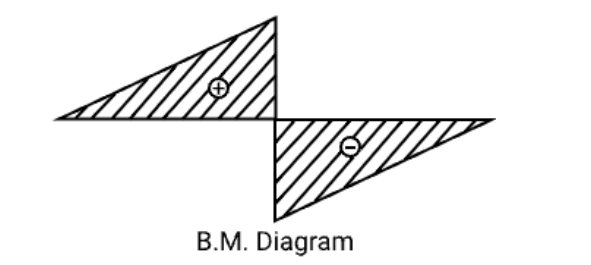
The bending moment diagram (BMD) for a simply supported beam carrying a uniformly distributed load over its entire span is:
In a multi-story portal frame, how does increasing the number of stories affect the moment distribution in the frame?
When reactions are found graphically for a simply supported beam with vertical point loads, the length of the reaction vector is proportional to:
In a homogenous and prismatic continuous beam under uniformly distributed load, the bending moment at an intermediate support is:
(Consider that the length of each intermediate span measures the same.)
Important Questions from Methods of Structural Analysis
A surface structure has:-
A single bay single storey portal frame has a hinged left support and fixed right support. It is loaded with a uniformly distributed load of w/m length on the beam. Which one of the following statements is true with regard to the deformation of the frame? Assume all the members have equal length.
In the structural analysis, the unit load method used is:
Who proposed the Theorem of Reciprocal Deflection?
Which method can be used to analyse the two or three dimensional members?