In a multi-story portal frame, how does increasing the number of stories affect the moment distribution in the frame?
The moments in the lower stories increase, while the upper stories experience lesser moments
In a multi-story portal frame, the distribution of moments through the structure is influenced by how forces are distributed across different levels of the frame. The correct answer to the problem statement is: The moments in the lower stories increase, while the upper stories experience lesser moments. Let us understand why this is the case, step by step:
- Understanding Portal Frames: Portal frames are structures subjected to lateral loads and are designed to endure moments, shear, and axial forces. They are commonly used in multi-story buildings.
- Effect of Multi-stories: As the number of stories in a portal frame increases, the dispersion of lateral loads due to wind or seismic effects results in varying moment distribution across the frame. This is because the structure has to sustain and transfer these loads effectively to the foundation.
- Moment Redistribution: In taller structures with more stories, the stiffness of the frame affects how moments are distributed. The lower stories, which are nearer to the fixed base, bear more load transfer, leading to increased moments. Conversely, the upper stories, as they are more flexible, experience lesser moments due to the displacement from the base, guiding much of their loads downward.
- Justification of the Correct Option: - Lower Stories Increasing Moments: With the increased number of stories, the moment at the base increases due to the accumulated effect of all stories above. - Upper Stories Lesser Moments: Since upper stories displace more freely, they absorb lesser bending moments comparatively.
Thus, when the number of stories in a portal frame is increased, the moment distribution changes such that lower stories take on higher moments than the upper stories. This phenomenon is largely due to the stiffness and load transfer characteristics of the frame's material and the structural integrities involved.
Similar Questions
The bending moment diagram (BMD) for a simply supported beam carrying a uniformly distributed load over its entire span is:
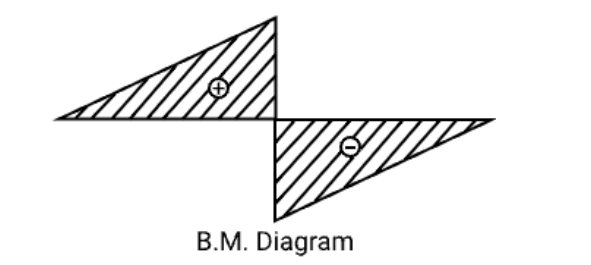
The following bending moment diagram corresponds to a simply supported beam. The diagram shows a sudden jump (discontinuity) in bending moment at a point between the supports. Which of the following loading conditions produces this type of bending moment diagram?
When reactions are found graphically for a simply supported beam with vertical point loads, the length of the reaction vector is proportional to:
In a homogenous and prismatic continuous beam under uniformly distributed load, the bending moment at an intermediate support is:
(Consider that the length of each intermediate span measures the same.)
A simply supported beam has a span of 6 m with an overhang of 4 m. A uniformly distributed load (UDL) of 6 kN/m acts over the overhang length of 4 m. What is the reaction at the nearest support?
Important Questions from Methods of Structural Analysis
A surface structure has:-
A single bay single storey portal frame has a hinged left support and fixed right support. It is loaded with a uniformly distributed load of w/m length on the beam. Which one of the following statements is true with regard to the deformation of the frame? Assume all the members have equal length.
In the structural analysis, the unit load method used is:
Who proposed the Theorem of Reciprocal Deflection?
Which method can be used to analyse the two or three dimensional members?