
When reactions are found graphically for a simply supported beam with vertical point loads, the length of the reaction vector is proportional to:
The magnitude of reaction force at the support
To solve this question, we need to understand the concept of reactions in a simply supported beam subjected to vertical point loads. Let’s break down the thought process:
- Understanding Reactions in Beams:
In structural analysis, a simply supported beam is a common structural element that resists loads applied perpendicular to its axis. It is supported at both ends, typically with a pinned support at one end and a roller support at the other. - Reaction Forces in Beams:
When vertical point loads are applied to such beams, reaction forces develop at the supports. The magnitude of these reaction forces depends on the location and magnitude of the applied loads. - Analyzing the Given Options:
- The span length of the beam only: The span length could affect the distribution of the forces but not directly proportional to the length of the reaction vector.
- The distance between loads: This affects how the loads interact but not how the force vector length is determined.
- The beam’s deflection at mid-span: Deflection is more related to stiffness and material properties, not directly to reaction force magnitude.
- The magnitude of reaction force at the support: Indeed, the length of the reaction vector is directly proportional to the magnitude of the reaction force itself.
- Conclusion:
The only option that directly explains the proportion of the reaction vector’s length is the magnitude of the reaction force at the support. This is because the graphical representation of reaction forces often involves vector lengths proportional to their magnitudes.
Therefore, the correct answer is: The magnitude of reaction force at the support.
Similar Questions
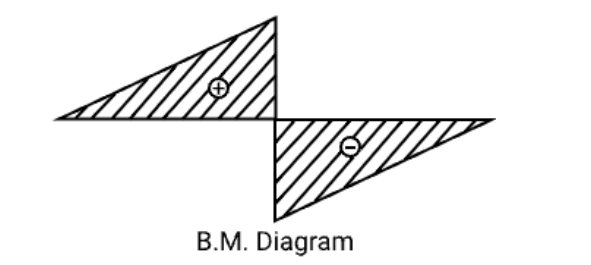
The following bending moment diagram corresponds to a simply supported beam. The diagram shows a sudden jump (discontinuity) in bending moment at a point between the supports. Which of the following loading conditions produces this type of bending moment diagram?
In a homogenous and prismatic continuous beam under uniformly distributed load, the bending moment at an intermediate support is:
(Consider that the length of each intermediate span measures the same.)
A simply supported beam has a span of 6 m with an overhang of 4 m. A uniformly distributed load (UDL) of 6 kN/m acts over the overhang length of 4 m. What is the reaction at the nearest support?
The bending moment diagram (BMD) for a simply supported beam carrying a uniformly distributed load over its entire span is:
In a multi-story portal frame, how does increasing the number of stories affect the moment distribution in the frame?
Important Questions from Methods of Structural Analysis
A continuous loaded beam ABC rests on simple supports at A,B and C without yielding (AB = L 1, and BC = L 2). Which one of the following represents correct equation of claperyron's three moment's theorem?
Clapeyron's theorem is also know as the theory of -
Bending moment at any section in a conjugate beam gives the actual beams
- Assertion (A): The slope deflection method is a stiffness method in which the joint displacements are found by applying the equilibrium conditions at each joint.
Reason (R) : The displacements at a joint of a member are independent of the displacements of the member at the far end of the joint. - The Moment Distribution Method was developed by Hardy Cross in



