
Pairs of adjacent sides of a big cube are coloured with red, yellow and brown colour. Now this big cube is divided into 64 small equal cubes. How many small cubes will have 3 faces painted with different colours?
2
Understanding the Cube Cutting Problem
This problem involves a large cube that is cut into many smaller, equal-sized cubes. The key is to figure out how the painting on the faces of the large cube affects the smaller cubes after cutting.
Analyzing the Big Cube Division
The big cube is divided into 64 small equal cubes. This means the number of small cubes along each edge of the big cube is the cube root of 64.
Let \(n\) be the number of divisions along each edge.
Total number of small cubes = \(n^3\)
Given, \(n^3 = 64\)
To find \(n\), we take the cube root:
\(n = \sqrt[3]{64}\)
\(n = 4\)
So, the big cube is divided into \(4 \times 4 \times 4\) small cubes.
Identifying Cubes with 3 Painted Faces
In any cube that is cut into \(n \times n \times n\) smaller cubes, the small cubes that have 3 faces painted are always the corner cubes of the original big cube. A big cube has 8 corners. Therefore, there are always 8 small cubes that originated from the corners.
These 8 corner cubes are the only ones that can have 3 faces exposed and thus potentially painted. All other types of small cubes have fewer than 3 exposed faces (edge cubes have 2, face-centred cubes have 1, and inner cubes have 0).
Analyzing the Colouring Scheme
The problem states that "Pairs of adjacent sides of a big cube are coloured with red, yellow and brown colour." This is an unusual colouring scheme. A common interpretation that fits such problems is that specific faces are coloured such that 3 pairs of adjacent faces get the colours.
Let's consider a possible interpretation where all 6 faces of the big cube are coloured using these three colours, with two adjacent faces sharing a colour:
- Pair 1: Two adjacent faces coloured Red (e.g., Top and Front faces)
- Pair 2: Two adjacent faces coloured Yellow (e.g., Right and Back faces)
- Pair 3: Two adjacent faces coloured Brown (e.g., Left and Bottom faces)
Under this colouring scheme, the colours of the 6 faces of the big cube are:
- Top: Red
- Front: Red
- Right: Yellow
- Back: Yellow
- Left: Brown
- Bottom: Brown
Determining Colours on Corner Cubes
Now we need to examine the 8 corner cubes and determine the colours on their three exposed faces. A corner cube is located where three faces of the big cube meet.
Let's list the faces meeting at each of the 8 corners and the colours of those faces according to our scheme:
- Corner 1: Meeting faces are Top, Front, Right. Colours are Red, Red, Yellow. (2 different colours)
- Corner 2: Meeting faces are Top, Front, Left. Colours are Red, Red, Brown. (2 different colours)
- Corner 3: Meeting faces are Top, Back, Right. Colours are Red, Yellow, Yellow. (2 different colours)
- Corner 4: Meeting faces are Top, Back, Left. Colours are Red, Yellow, Brown. (3 different colours)
- Corner 5: Meeting faces are Bottom, Front, Right. Colours are Brown, Red, Yellow. (3 different colours)
- Corner 6: Meeting faces are Bottom, Front, Left. Colours are Brown, Red, Brown. (2 different colours)
- Corner 7: Meeting faces are Bottom, Back, Right. Colours are Brown, Yellow, Yellow. (2 different colours)
- Corner 8: Meeting faces are Bottom, Back, Left. Colours are Brown, Yellow, Brown. (2 different colours)
Counting Cubes with 3 Different Colours
From the analysis above, we can see which corner cubes have their three exposed faces painted with three *different* colours (Red, Yellow, and Brown).
- Corner 4 (Top, Back, Left): Colours are Red, Yellow, Brown. These are 3 different colours.
- Corner 5 (Bottom, Front, Right): Colours are Brown, Red, Yellow. These are 3 different colours.
All other 6 corner cubes have only two different colours on their painted faces according to this specific colouring scheme.
Therefore, there are 2 small cubes that have 3 faces painted with different colours (Red, Yellow, and Brown).
Revision Table: Cube Properties (n=4)
| Type of Cube | Location | Number of Painted Faces | Formula (for standard 6-face painting) | Count (for n=4, standard painting) |
|---|---|---|---|---|
| Corner Cubes | At the 8 vertices | 3 | 8 | 8 |
| Edge Cubes | Along the 12 edges (excluding corners) | 2 | \(12(n-2)\) | \(12(4-2) = 12 \times 2 = 24\) |
| Face-Centred Cubes | On the 6 faces (excluding edges) | 1 | \(6(n-2)^2\) | \(6(4-2)^2 = 6 \times 2^2 = 6 \times 4 = 24\) |
| Inner Cubes | Inside the cube | 0 | \((n-2)^3\) | \((4-2)^3 = 2^3 = 8\) |
| Total small cubes = \(8 + 24 + 24 + 8 = 64\). This matches \(n^3 = 4^3 = 64\). | ||||
Note: The standard formulas in the table count the number of cubes with a certain number of painted faces assuming all 6 faces of the big cube were painted. However, this problem has a specific colouring scheme that affects the *colours* on the faces, requiring a more detailed analysis of each corner cube as performed above.
Additional Information: Cube Colouring Variations
Cube cutting problems can have different colouring patterns, which affect the number of small cubes with certain colour combinations. Some variations include:
- Painting all 6 faces with the same colour.
- Painting opposite faces with the same colour (3 colours total).
- Painting adjacent faces with different colours (minimum 3 colours, up to 6 colours).
- Painting only a specific number of faces (e.g., 1, 2, 3 adjacent, or 4 adjacent, or 5).
For problems asking about specific colour combinations, simply knowing the number of painted faces is not enough; the exact positioning and colours of the paint on the original cube's faces must be considered, especially for corner and edge cubes.
Important Questions from Cube and Dice
Three different positions of the same dice are shown, the six faces of which are numbered from 1 to 6. Select the number that will be on the face opposite to the one having '1'.
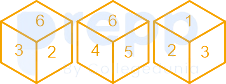
A cube of side 4 cm is painted green on all its faces and then divided into smaller cubes of side 2 cm each. How many small cubes have been obtained?
Two adjacent faces of a solid cube are painted with black colour. The faces opposite to the black faces is painted with blue colour while the remaining faces are painted with yellow colour. After painting, this cube has been divided into 125 equal cubes. How many cubes have no faces painted?
A cube is painted blue on two adjacent faces and on one opposite face, green on two opposite faces and pink on the remaining face. It is then cut into 64 equal cubes. How many cubes have only one blue-coloured face?
A cube, whose two adjacent faces are coloured, is cut into 64 identical small cubes. How many of these small cubes are not coloured at all?


