
A cube is painted blue on two adjacent faces and on one opposite face, green on two opposite faces and pink on the remaining face. It is then cut into 64 equal cubes. How many cubes have only one blue-coloured face?
12
Finding Cubes with Only One Blue Face
This problem involves a large cube that has been painted on its faces with different colors and then cut into many smaller equal cubes. We need to determine how many of these small cubes have only one face that is blue.
Understanding the Cube Cut
The large cube is cut into 64 equal small cubes. When a cube is cut into \(N \times N \times N\) equal smaller cubes, the total number of small cubes is \(N^3\). In this case, \(N^3 = 64\). Therefore, \(N = \sqrt[3]{64} = 4\). This means the large cube was cut into a \(4 \times 4 \times 4\) grid of smaller cubes.
For a \(4 \times 4 \times 4\) cube:
- Each face of the large cube is divided into \(4 \times 4 = 16\) small squares.
- There are 4 layers of \(4 \times 4 = 16\) cubes each.
Analyzing the Painting Pattern
The large cube is painted as follows:
- Blue: Two adjacent faces and one opposite face. Let's assume the Top and Front faces are adjacent blue faces. The face opposite to either Top (Bottom) or Front (Back) is also blue. Let's take the face opposite to the Top, which is the Bottom face, to be blue. So, the blue faces are Top, Front, and Bottom (3 faces).
- Green: Two opposite faces. With Top, Front, and Bottom being blue, the remaining unpainted faces are Back, Left, and Right. The opposite pairs among these are Left and Right, and Front and Back. Since Front is blue, the green faces must be the opposite pair Left and Right (2 faces).
- Pink: The remaining face. The only remaining unpainted face is Back (1 face).
So, the painting distribution is:
- Blue: 3 faces (e.g., Top, Front, Bottom)
- Green: 2 faces (e.g., Left, Right)
- Pink: 1 face (e.g., Back)
Total faces painted = 3 + 2 + 1 = 6. This distribution covers all faces of the cube.
Identifying Single-Face Painted Cubes
When a cube is cut, the small cubes can have 3, 2, 1, or 0 faces painted, depending on their original position in the large cube:
- Corner cubes: Located at the vertices of the large cube. They have 3 faces painted. There are always 8 corner cubes.
- Edge cubes (not corners): Located along the edges, but not at the vertices. They have 2 faces painted.
- Face cubes (center): Located in the center of each face of the large cube, away from edges and corners. They have only 1 face painted.
- Interior cubes: Located inside the large cube. They have 0 faces painted.
We are interested in the small cubes that have only one blue-coloured face. These are the face cubes (center cubes) that are located on the faces of the original large cube that were painted blue.
Calculating Cubes with Only One Blue Face
For an \(N \times N \times N\) cube, the number of small cubes with only one face painted on a single large face is given by \((N-2)^2\). Here, \(N=4\).
Number of single-face painted cubes on one face = \((4-2)^2 = 2^2 = 4\).
This means there are 4 cubes in the center of each face of the large cube that have only one face painted (that face having the color of the large face).
We need to find the number of these single-face cubes that are specifically blue. We simply count the number of faces on the large cube that were painted blue and multiply by the number of single-face cubes per face.
Number of blue faces = 3 (Top, Front, Bottom in our example).
Number of cubes with only one blue-coloured face = (Number of blue faces) \(\times\) (Number of single-face cubes per face)
Number of cubes with only one blue-coloured face = \(3 \times (4-2)^2\)
Number of cubes with only one blue-coloured face = \(3 \times 2^2\)
Number of cubes with only one blue-coloured face = \(3 \times 4\)
Number of cubes with only one blue-coloured face = \(12\)
Thus, there are 12 small cubes that have only one blue-coloured face.
Important Questions from Cube and Dice
Three different positions of the same dice are shown, the six faces of which are numbered from 1 to 6. Select the number that will be on the face opposite to the one having '1'.
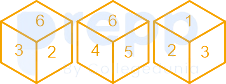
Pairs of adjacent sides of a big cube are coloured with red, yellow and brown colour. Now this big cube is divided into 64 small equal cubes. How many small cubes will have 3 faces painted with different colours?
A cube of side 4 cm is painted green on all its faces and then divided into smaller cubes of side 2 cm each. How many small cubes have been obtained?
Two adjacent faces of a solid cube are painted with black colour. The faces opposite to the black faces is painted with blue colour while the remaining faces are painted with yellow colour. After painting, this cube has been divided into 125 equal cubes. How many cubes have no faces painted?
A cube, whose two adjacent faces are coloured, is cut into 64 identical small cubes. How many of these small cubes are not coloured at all?


