
Which one of the following arrangements suits them the most?
Evaluating Hostel Room Arrangements
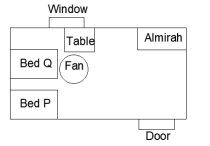
The problem asks for the best hostel room arrangement for P and Q based on their specific preferences.
- P's Preference: Needs the study table positioned near the window to watch birds.
- Q's Preference: Needs his bed to be close to the ceiling fan for comfort.
We need to find an arrangement that satisfies both conditions simultaneously.
Analyzing Arrangement Options
Let's examine the options based on the provided images and the preferences:
- Option 1: This arrangement places the study table adjacent to the window, fulfilling P's requirement. It also places one of the beds sufficiently close to the ceiling fan, meeting Q's preference.
- Option 2, 3, 4: These arrangements may not optimally satisfy both P and Q. For instance, the study table might be far from the window, or the beds might be poorly positioned relative to the fan.
Conclusion on Best Fit
Option 1 is the most suitable arrangement because it directly addresses both P's desire to use the study table for bird-watching by the window and Q's need for a bed near the ceiling fan.
Important Questions from Seating Arrangement
Seven cars P, Q, R, S, T, U and V are parked in a row not necessarily in that order. The cars T and U should be parked next to each other. The cars S and V also should be parked next to each other, whereas P and Q cannot be parked next to each other. Q and S must be parked next to each other. R is parked to the immediate right of V. T is parked to the left of U.
Based on the above statements, the only INCORRECT option given below is:- P, Q, R, S, T and U are seated around a circular table. R is seated two places to the right of Q. P is seated three places to the left of R. S is seated opposite U. If P and U now switch seats, which of the following must necessarily be true?
Five persons P, Q, R, S and T are sitting in a row not necessarily in the same order. Q and R are separated by one person, and S should not be seated adjacent to Q.
The number of distinct seating arrangements possible is:
- S, T, U, V, W, X, Y, and Z are seated around a circular table. T's neighbours are Y and V. Z is seated third to the left of T and second to the right of S. U's neighbours are S and Y; and T and W are not seated opposite each other. Who is third to the left of V?
- Five persons P, Q, R, S and T are to be seated in a row, all facing the same direction, but not necessarily in the same order. P and T cannot be seated at either end of the row. P should not be seated adjacent to S. R is to be seated at the second position from the left end of the row. The number of distinct seating arrangements possible is:


