
The given problem involves a simply supported beam with a non-uniform distribution of weight. This type of problem is typically solved by analyzing the shear force and bending moment diagrams to determine the location of the maximum bending moment.
Let's break down the problem:
- Understanding the Load Distribution: The beam is divided into two halves. The weight on the first half is \(W\), and the weight on the other half is \(2W\), resulting in an asymmetrical load distribution across the beam.
- Reaction Forces at the Supports: Since the beam is simply supported, it experiences reaction forces at both ends. Due to the asymmetry, these reactions will not be equal.
- Finding the Bending Moment: - To find the bending moment at any section, we use the equilibrium equations. - The bending moment at any point along the beam is the sum of the moments due to external forces to the left (or right) of the section.
- Maximum Bending Moment Location: - In a non-uniformly loaded beam, such as this one, the point of maximum bending moment does not necessarily occur at the midpoint. - The correct approach involves calculating the bending moment across the beam span and identifying the point where it is maximum.
The given problem states that the maximum bending moment occurs at \(\frac{L}{16}\) from the midpoint of the beam. To be specific:
- The bending moment is highest at a point \(\frac{L}{16}\) from the midpoint towards the section that bears the heavier load.
- Therefore, in this case, it will be \(\frac{L}{16}\) towards the section with weight \(2W\).
Hence, among the given options, the correct location of the maximum bending moment is indeed \(\frac{L}{16}\) from the midpoint of the beam.
Important Questions from Strength of Materials
- A simply-supported steel beam made of an I-section has a span of $8 \text{ m}$. The beam is carrying a uniformly distributed load of $15 \text{ kN/m}$. The overall depth of the beam is $450 \text{ mm}$. The moment of inertia of the beam section is $18000$ cm$^4$. The maximum bending stress in the beam will be _________ N/mm$^2$. [in integer]
A simply supported RCC beam of cross section $0.4 \text{ m} \times 0.6 \text{ m}$ covers a span of $8 \text{ m}$. It is subjected to a uniformly distributed load of $30 \text{ kN/m}$. If the unit weight of concrete is $24 \text{ kN/m}^3$, the tensile stress (in $N/mm^2$, rounded off to two decimal places) at the bottom of the beam at mid-span is______
A rectangular beam section of size 300 mm (width) X 500 mm (depth) is loaded with a shear force of 600 kN. The maximum shear stress on the section in N/mm² is ___________
- A steel I-beam section is subjected to a bending moment of 96 kN-m. The moment of inertia of the beam section is $24,000 \text{ cm}^4$. The bending stress at 100 mm above the neutral axis of the beam in MPa will be ________
A simply supported beam AB has a clear span of 7 meter. The bending moment diagram (BMD) of the beam due to a single concentrated load is shown in the figure below.
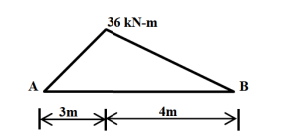
The magnitude of the concentrated load in kN is __________.


