
Calculating Bending Stress in Steel I-Beam
This solution calculates the bending stress ($\sigma$) in a steel I-beam using the flexure formula.
Given Data
- Bending Moment, $M = 96 \text{ kN-m}$
- Moment of Inertia, $I = 24,000 \text{ cm}^4$
- Distance from neutral axis, $y = 100 \text{ mm}$
Unit Conversion
To use the flexure formula consistently, convert all units to N and mm:
- Moment: $ M = 96 \text{ kN-m} = 96 \times 10^3 \text{ N} \times 1000 \text{ mm} = 96 \times 10^6 \text{ N-mm} $
- Moment of Inertia: $ I = 24,000 \text{ cm}^4 = 24,000 \times (10 \text{ mm})^4 = 24,000 \times 10,000 \text{ mm}^4 = 240 \times 10^6 \text{ mm}^4 $
- Distance: $ y = 100 \text{ mm} $
Flexure Formula
The bending stress is calculated using the formula:
$ \sigma = \frac{M \cdot y}{I} $
Stress Calculation
Substitute the converted values into the formula:
$ \sigma = \frac{(96 \times 10^6 \text{ N-mm}) \times (100 \text{ mm})}{240 \times 10^6 \text{ mm}^4} $
Simplify the expression:
$ \sigma = \frac{96 \times 100}{240} \text{ N/mm}^2 $
$ \sigma = \frac{9600}{240} \text{ N/mm}^2 $
$ \sigma = 40 \text{ N/mm}^2 $
Result
Since $1 \text{ N/mm}^2 = 1 \text{ MPa}$, the bending stress is:
$ \sigma = 40 \text{ MPa} $
Important Questions from Strength of Materials
- A simply-supported steel beam made of an I-section has a span of $8 \text{ m}$. The beam is carrying a uniformly distributed load of $15 \text{ kN/m}$. The overall depth of the beam is $450 \text{ mm}$. The moment of inertia of the beam section is $18000$ cm$^4$. The maximum bending stress in the beam will be _________ N/mm$^2$. [in integer]
A simply supported RCC beam of cross section $0.4 \text{ m} \times 0.6 \text{ m}$ covers a span of $8 \text{ m}$. It is subjected to a uniformly distributed load of $30 \text{ kN/m}$. If the unit weight of concrete is $24 \text{ kN/m}^3$, the tensile stress (in $N/mm^2$, rounded off to two decimal places) at the bottom of the beam at mid-span is______
A rectangular beam section of size 300 mm (width) X 500 mm (depth) is loaded with a shear force of 600 kN. The maximum shear stress on the section in N/mm² is ___________
A simply supported beam AB has a clear span of 7 meter. The bending moment diagram (BMD) of the beam due to a single concentrated load is shown in the figure below.
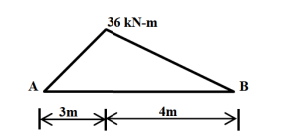
The magnitude of the concentrated load in kN is __________.- A load of 30 kN is applied vertically downward at the free end of a cantilever of span 5 m. If the elastic modulus of the cantilever is 30 GPa and the section has a width of 0.3 m and a depth of 0.6 m, then, the elastic deflection (in mm) is ________


