
Mollusc taxa Order I Cone snails P Bivalve II Octopuses Q Gastropod III Giant clams R Cephalopod IV Squids
Mollusc Taxa to Order Matching
This question requires matching specific mollusc taxa to their correct biological orders. Understanding the defining characteristics of each mollusc group is key to solving this.
Matching Mollusc Taxa and Orders
Let's analyze each taxon:
- Cone snails (I): These are marine snails, which are characterized by a single shell (often coiled) and belong to the class Gastropoda. Thus, I matches with Q (Gastropod).
- Octopuses (II): Octopuses are marine animals with eight arms and are known for their intelligence. They belong to the class Cephalopoda. Thus, II matches with R (Cephalopod).
- Giant clams (III): Clams are filter feeders enclosed within two hinged shells. This characteristic places them in the class Bivalvia. Thus, III matches with P (Bivalve).
- Squids (IV): Squids, like octopuses, possess tentacles and are highly mobile marine molluscs. They also belong to the class Cephalopoda. Thus, IV matches with R (Cephalopod).
Final Matching
Based on the analysis, the correct matching is:
- Cone snails (I) - Gastropod (Q)
- Octopuses (II) - Cephalopod (R)
- Giant clams (III) - Bivalve (P)
- Squids (IV) - Cephalopod (R)
This corresponds to the pairing I-Q; II-R; III-P; IV-R.
Important Questions from Community structure
Forest patches are embedded within a landscape dominated by crop fields. The crop fields around fragmented forest patches are thought to affect the abundance of different butterfly species to different extents. The graph below shows the pattern of butterfly abundance (means, and error bars representing 95% confidence intervals) of three species, M, N, and O between the forest patches and the crop fields.
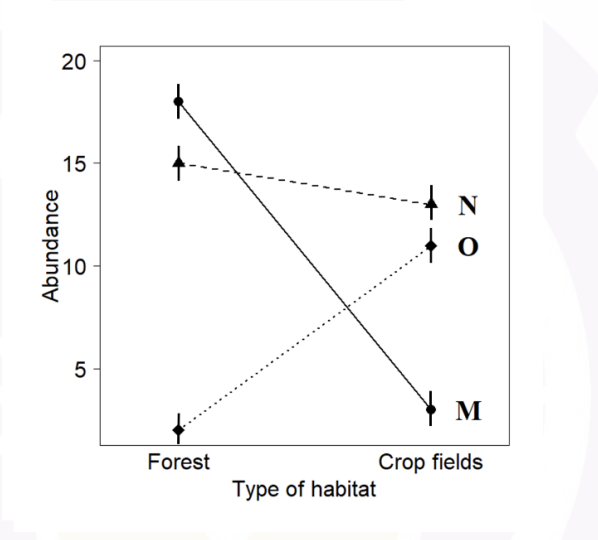
Which one of the following options best describes the impact of fragmentation on the three different butterfly species?
- Local communities are comprised of a subset of species from the regional species pool. Which one of the following processes is LEAST likely to cause species composition of local communities to differ from one another?


