
Understanding Local vs. Regional Species Composition
Local communities are assemblies of species found within a specific area, drawn from a larger pool of species available in the surrounding region (the regional species pool). The question asks which factor is least likely to make the species lists (composition) of different local communities distinct from each other.
Analyzing Factors Causing Community Differences
Several ecological processes can influence which species establish and persist in a local community, potentially leading to differences between communities:
- Local interspecific competition: Competition for resources occurs within a local community. If different local communities experience different competitive interactions or have different dominant competitors, this can lead to varying species compositions.
- Stochastic demographic variation: Random events in birth rates, death rates, and environmental factors affect populations locally. These unpredictable fluctuations can cause species to wink in and out of existence in a specific local community, leading to divergence over time compared to other communities.
- Local predator-prey interactions: The presence and impact of predators shape prey populations. If predator-prey dynamics differ significantly between local areas (e.g., different predators are present, or predation intensity varies), it will result in different species compositions.
Role of Regionally Stable Climatic Conditions
Regionally stable climatic conditions represent a factor that is consistent across the entire region. Stability implies uniformity. If the climate is stable throughout the region:
- It provides a consistent environmental filter, allowing the same set of species (those adapted to that stable climate) to potentially colonize or survive in any local community within that region.
- While local factors (like competition or random events) will still cause some differences between local communities, the stable regional climate itself is less likely to be a *source* of divergence. Instead, it acts more as a unifying factor for the regional species pool available to local communities.
Therefore, stable regional climate is the process LEAST likely to cause local communities to differ from one another, as it promotes environmental similarity across the region.
Important Questions from Community structure
Forest patches are embedded within a landscape dominated by crop fields. The crop fields around fragmented forest patches are thought to affect the abundance of different butterfly species to different extents. The graph below shows the pattern of butterfly abundance (means, and error bars representing 95% confidence intervals) of three species, M, N, and O between the forest patches and the crop fields.
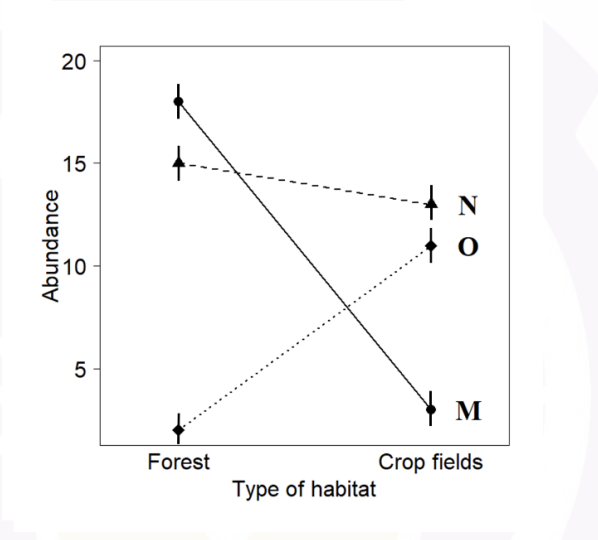
Which one of the following options best describes the impact of fragmentation on the three different butterfly species?
- Match the mollusc taxa to their respective orders.
Mollusc taxa Order I Cone snails P Bivalve II Octopuses Q Gastropod III Giant clams R Cephalopod IV Squids


