
Match List-I with List-II Choose the Correct answer from the options given below:
List-1 List-II (A) If X and Y are two sets such that n(X)= 17, n(Y)=23, n(X $\cup$ Y)=38, then n(X $\cap$ Y) is (I) 20 (B)) If n(X) = 28,n(Y) = 32,n(X$\cap$Y) = 10, then n(X$\cup$Y) is (II) 10 (C) If n(X) = 10, then n(7X) is (III) 50 (D) If n(Y) = 20, then n($\frac{Y}{2}$) is (IV) 2
Set Theory and Cardinality Matching Solution
This question requires matching statements about the cardinalities of sets from List-I with their corresponding numerical values from List-II. We will analyze each item in List-I, applying relevant set theory formulas and concepts.
Analyzing List-I Item (A) for Intersection
Item (A) presents a scenario with two sets, X and Y, where $n(X) = 17$, $n(Y) = 23$, and $n(X \cup Y) = 38$. The goal is to find $n(X \cap Y)$.
Concept: The Principle of Inclusion-Exclusion for two sets is applied here. It states that $n(X \cup Y) = n(X) + n(Y) - n(X \cap Y)$.
Calculation: To determine $n(X \cap Y)$, we rearrange the formula:
\begin{equation*} n(X \cap Y) = n(X) + n(Y) - n(X \cup Y) \end{equation*}
Substituting the given values:
\begin{equation*} n(X \cap Y) = 17 + 23 - 38 \end{equation*}
\begin{equation*} n(X \cap Y) = 40 - 38 \end{equation*}
\begin{equation*} n(X \cap Y) = 2 \end{equation*}
The calculation yields a value of 2. The corresponding match for List-I item (A) from List-II is (II).
Analyzing List-I Item (B) for Union
Item (B) provides cardinalities for sets X and Y: $n(X) = 28$, $n(Y) = 32$, and $n(X \cap Y) = 10$. We need to find $n(X \cup Y)$.
Concept: The Principle of Inclusion-Exclusion is used again:
\begin{equation*} n(X \cup Y) = n(X) + n(Y) - n(X \cap Y) \end{equation*}
Calculation: Substitute the provided values into the formula:
\begin{equation*} n(X \cup Y) = 28 + 32 - 10 \end{equation*}
\begin{equation*} n(X \cup Y) = 60 - 10 \end{equation*}
\begin{equation*} n(X \cup Y) = 50 \end{equation*}
The calculation results in 50. The corresponding match for List-I item (B) from List-II is (I).
Analyzing List-I Item (C) for Scaled Cardinality
Item (C) gives the cardinality of set X as $n(X) = 10$, and asks for $n(7X)$.
Concept: The notation $n(kX)$ typically signifies scaling the cardinality of set X by a factor $k$, meaning $n(kX) = k \times n(X)$. This operation scales the count of elements.
Calculation: Applying this concept:
\begin{equation*} n(7X) = 7 \times n(X) \end{equation*}
\begin{equation*} n(7X) = 7 \times 10 \end{equation*}
\begin{equation*} n(7X) = 70 \end{equation*}
The calculation yields 70. The corresponding match for List-I item (C) from List-II is (IV).
Analyzing List-I Item (D) for Fractional Cardinality
Item (D) provides the cardinality of set Y as $n(Y) = 20$, and asks for $n(\frac{Y}{2})$.
Concept: Similarly, $n(\frac{Y}{k})$ indicates scaling the cardinality of set Y by $\frac{1}{k}$, i.e., $n(\frac{Y}{k}) = \frac{1}{k} \times n(Y)$. This represents a proportional reduction in the element count.
Calculation: Applying this concept:
\begin{equation*} n\left(\frac{Y}{2}\right) = \frac{1}{2} \times n(Y) \end{equation*}
\begin{equation*} n\left(\frac{Y}{2}\right) = \frac{1}{2} \times 20 \end{equation*}
\begin{equation*} n\left(\frac{Y}{2}\right) = 10 \end{equation*}
The calculation results in 10. The corresponding match for List-I item (D) from List-II is (III).
Summary of Matches
Based on the analysis, the matches between List-I and List-II are established as follows:
| List-I Item | List-II Match |
|---|---|
| (A) | (II) |
| (B) | (I) |
| (C) | (IV) |
| (D) | (III) |
The correct option is 1: (A) - (II), (B) - (I), (C) - (IV), (D) - (III).
Important Questions from Set Theory and Venn Diagram (Notes)
- From the given sets, which is an infinite set:
1. {x: x $\in$ N and (x-1)(x-2) = 0}
2. {x: x $\in$ N and x is prime number and less than 199}
3. {x: x $\in$ N and x$^5$ - 1 = 0}
4. {x: x $\in$ N and x is odd} Consider the following relation R={(4,5),(5,4), (7,6),(6,7)} on set I={4,5,6,7}. Which of the following properties relation R does not have?
A. Reflexive property
B. Symmetric property
C. Transitive property
D. Antisymmetric property
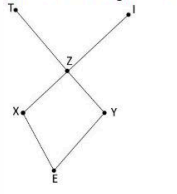
Choose the correct answer from the options given below:Find the least upper bound and greatest lower bound of $S=\{X,Y,Z\}$ if they exist, of the poset whose Hasse diagram is shown below:
- In a class, 40 like Math, 35 like Science, 30 like English; 15 like both Math and Science, 12 like Math and English, 10 like Science and English, 5 like all three. How many like atleast one?
- Based on a survey of 200 students, 140 students like cold drinks, 120 students like milkshakes, and 80 students like both. How many students like at least one of the drinks ?


