
Understanding the Set Theory Problem
This problem requires us to find the total number of students who like at least one subject among Math, Science, and English. We are given information about how many students like each subject individually, how many like pairs of subjects, and how many like all three subjects. This is a classic application of the Principle of Inclusion-Exclusion.
Identifying the Given Data
Let's define the sets:
- $M$: Set of students who like Math
- $S$: Set of students who like Science
- $E$: Set of students who like English
From the question, we have the following counts:
- Number of students who like Math: $|M| = 40$
- Number of students who like Science: $|S| = 35$
- Number of students who like English: $|E| = 30$
- Number of students who like Math and Science: $|M \cap S| = 15$
- Number of students who like Math and English: $|M \cap E| = 12$
- Number of students who like Science and English: $|S \cap E| = 10$
- Number of students who like all three subjects: $|M \cap S \cap E| = 5$
Applying the Principle of Inclusion-Exclusion
The Principle of Inclusion-Exclusion is used to find the total number of elements in the union of multiple sets. For three sets ($M$, $S$, and $E$), the formula to find the number of elements in at least one set (i.e., $|M \cup S \cup E|$) is:
$ |M \cup S \cup E| = |M| + |S| + |E| - (|M \cap S| + |M \cap E| + |S \cap E|) + |M \cap S \cap E| $
This formula systematically counts each student exactly once:
- It adds everyone who likes Math, Science, and English individually.
- It subtracts those who like two subjects because they were counted twice in the first step.
- It adds back those who like all three subjects because they were added three times initially and then subtracted three times in the second step (once for each pair they belong to), effectively removing them from the count.
Step-by-Step Calculation
Now, let's substitute the given values into the formula:
Step 1: Sum the counts for each individual subject.
$ |M| + |S| + |E| = 40 + 35 + 30 = 105 $
Step 2: Sum the counts for each pair of subjects.
$ |M \cap S| + |M \cap E| + |S \cap E| = 15 + 12 + 10 = 37 $
Step 3: Substitute these sums and the count for all three subjects into the Inclusion-Exclusion formula.
$ |M \cup S \cup E| = (40 + 35 + 30) - (15 + 12 + 10) + 5 $
$ |M \cup S \cup E| = 105 - 37 + 5 $
Step 4: Perform the final calculation.
$ |M \cup S \cup E| = 68 + 5 $
$ |M \cup S \cup E| = 73 $
Conclusion
Following the Principle of Inclusion-Exclusion with the provided numbers, the total number of students who like at least one subject (Math, Science, or English) is 73.
Important Questions from Set Theory and Venn Diagram (Notes)
Match List-I with List-II
List-1 List-II (A) If X and Y are two sets such that n(X)= 17, n(Y)=23, n(X $\cup$ Y)=38, then n(X $\cap$ Y) is (I) 20 (B)) If n(X) = 28,n(Y) = 32,n(X$\cap$Y) = 10, then n(X$\cup$Y) is (II) 10 (C) If n(X) = 10, then n(7X) is (III) 50 (D) If n(Y) = 20, then n($\frac{Y}{2}$) is (IV) 2 Choose the Correct answer from the options given below:
- From the given sets, which is an infinite set:
1. {x: x $\in$ N and (x-1)(x-2) = 0}
2. {x: x $\in$ N and x is prime number and less than 199}
3. {x: x $\in$ N and x$^5$ - 1 = 0}
4. {x: x $\in$ N and x is odd} Consider the following relation R={(4,5),(5,4), (7,6),(6,7)} on set I={4,5,6,7}. Which of the following properties relation R does not have?
A. Reflexive property
B. Symmetric property
C. Transitive property
D. Antisymmetric property
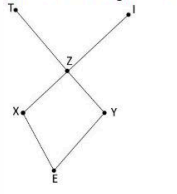
Choose the correct answer from the options given below:Find the least upper bound and greatest lower bound of $S=\{X,Y,Z\}$ if they exist, of the poset whose Hasse diagram is shown below:
- Based on a survey of 200 students, 140 students like cold drinks, 120 students like milkshakes, and 80 students like both. How many students like at least one of the drinks ?


