
Slab to Beam Load Transfer Mechanism
Loads applied on a slab, such as floor or roof loads, are transferred to supporting structural elements. When a slab is supported by beams, the load transfer primarily occurs at the interface between the slab and the beam.
Understanding Force Transfer
The primary way a slab transfers its load to a supporting beam is through the development of forces at their connection point.
- Shearing Force: This is the dominant force mechanism. The distributed load on the slab creates a downward vertical force at the edge where it rests on the beam. This vertical action, tending to 'shear' the slab off the beam, is the primary load transfer.
- Bending Moment: While the slab itself experiences bending moments, and it does transfer some moment effects to the beam (especially in continuous construction), the direct transfer of the slab's vertical load is fundamentally a shear action.
- Axial Force: Axial forces (tension or compression along the axis) are not the primary means of transferring the slab's distributed vertical load onto the beam.
- Torsion: Torsion (twisting) occurs mainly due to eccentric loads or specific support conditions, and it is generally not the principal way slab loads are transferred to beams in standard configurations.
Therefore, the shearing force is the most direct and primary way the load moves from the slab to the beam.
Important Questions from Design of Structural Elements
- The slenderness ratio of a circular column of diameter $300 \text{ mm}$ and effective height $3 \text{ m}$ is _________ [in integer]
- Match the structural system in Group I with their potential causes of failure in Group II
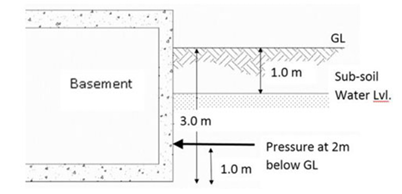
Group I Group II (P) Flat Slab (1) Thrust (Q) Long Column (2) Flutter (R) Arch (3) Punching Shear (S) Tensile Fabric (4) Buckling (5) Moment A basement wall resists lateral pressure exerted by soil and water. The soil pressure amounts to $4.5 \text{ kN/m}^2$ for every metre of depth below Ground Level (GL). The sub-soil water level is $1.0 \text{ m}$ below GL and hydrostatic pressure of water is $9.8 \text{ kN/m}^2$ for every metre of depth below GL. The total lateral pressure (in $kN/m^2$, rounded off to one decimal place) exerted on the wall $2 \text{ m}$ below GL is______
- Slenderness ratio of a column is represented as:
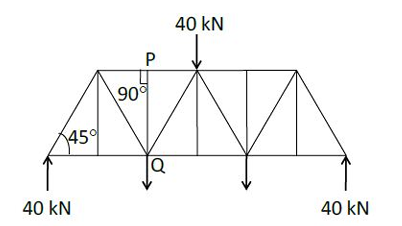
For a symmetrical two dimensional truss as shown in the above figure, vertical force in kN acting on the member PQ is ________


