
Calculate Column Slenderness Ratio
The slenderness ratio is a critical measure for columns, indicating their tendency to buckle under load. It relates the column's effective length to its radius of gyration.
Slenderness Ratio Formula
The formula for the slenderness ratio is:
$ \text{Slenderness Ratio} = \frac{L_e}{r} $
Where $L_e$ is the effective height and $r$ is the least radius of gyration.
Column Radius of Gyration (r)
For a circular cross-section, the radius of gyration ($r$) is calculated using the diameter ($D$):
$ r = \frac{D}{4} $
Given the diameter $D = 300 \text{ mm}$:
$ r = \frac{300 \text{ mm}}{4} = 75 \text{ mm} $
Column Effective Height (Le)
The effective height $L_e$ is given as $3 \text{ m}$. We need consistent units, so convert meters to millimeters:
$ L_e = 3 \text{ m} \times 1000 \frac{\text{mm}}{\text{m}} = 3000 \text{ mm} $
Determine Slenderness Ratio
Substitute the calculated values of $L_e$ and $r$ into the slenderness ratio formula:
$ \text{Slenderness Ratio} = \frac{3000 \text{ mm}}{75 \text{ mm}} $
$ \text{Slenderness Ratio} = 40 $
The calculation yields an integer value.
Important Questions from Design of Structural Elements
- Match the structural system in Group I with their potential causes of failure in Group II
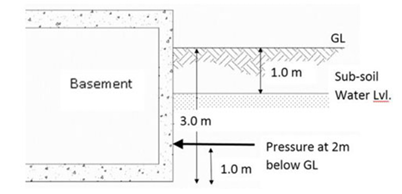
Group I Group II (P) Flat Slab (1) Thrust (Q) Long Column (2) Flutter (R) Arch (3) Punching Shear (S) Tensile Fabric (4) Buckling (5) Moment A basement wall resists lateral pressure exerted by soil and water. The soil pressure amounts to $4.5 \text{ kN/m}^2$ for every metre of depth below Ground Level (GL). The sub-soil water level is $1.0 \text{ m}$ below GL and hydrostatic pressure of water is $9.8 \text{ kN/m}^2$ for every metre of depth below GL. The total lateral pressure (in $kN/m^2$, rounded off to one decimal place) exerted on the wall $2 \text{ m}$ below GL is______
- Slenderness ratio of a column is represented as:
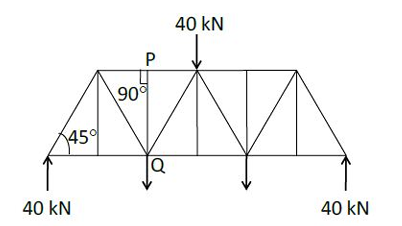
For a symmetrical two dimensional truss as shown in the above figure, vertical force in kN acting on the member PQ is ________
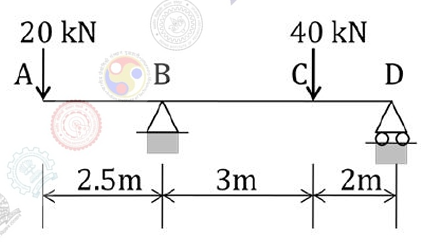
Value of bending moment in kN-m at point C for a beam as shown in the above figure is ________


