
For a symmetrical two dimensional truss as shown in the above figure, vertical force in kN acting on the member PQ is ________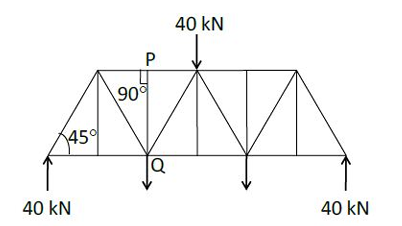
Analysis of Force in Member PQ
The problem asks for the vertical force (axial force) in the member PQ of the symmetrical truss. We will use the Method of Joints, starting from the left support and proceeding towards Joint Q.
Let's label the joints from left to right on the bottom chord: $L_1$ (support), $L_2$ (Joint Q), $L_3$, etc. And the top chord: $U_1$, $U_2$ (Joint P), $U_3$, etc. The member in question is $PQ$ (which is $U_2L_2$).
The truss is symmetrical, and the external loads consist of upward reactions ($40 \text{ kN}$) at the ends and downward loads ($40 \text{ kN}$) at the central top and bottom joints ($U_2$ and $L_2$). Given the symmetry and the balanced loading, the external reactions are indeed $40 \text{ kN}$ at each end.
The angle of the inclined members is $45^\circ$. (Assuming the bays are square and the truss height equals the half-bay width).
Step 1: Analyze Joint $L_1$ (Left Support)
Let $F_{L1U1}$ be the force in the diagonal member and $R_{L1} = 40 \text{ kN}$ be the reaction.
Applying vertical equilibrium ($\sum F_y = 0$, upward positive):
$$R_{L1} + F_{L1U1} \sin(45^\circ) = 0$$
$$40 + F_{L1U1} \left(\frac{1}{\sqrt{2}}\right) = 0$$
$$F_{L1U1} = -40\sqrt{2} \text{ kN (Compression)}$$
Step 2: Analyze Joint $U_1$ (Top Joint above $L_2$)
The members connecting $U_1$ are $L_1U_1$, $U_1L_2$, and the top chord members. We need the force $F_{U1L2}$ (the diagonal member connecting $U_1$ to Q, which is $L_2$).
Applying vertical equilibrium ($\sum F_y = 0$):
The vertical component of $F_{L1U1}$ (compression) acts down. The vertical component of $F_{U1L2}$ (assumed tension) acts up.
$$F_{U1L2} \sin(45^\circ) - |F_{L1U1}| \sin(45^\circ) = 0$$
$$F_{U1L2} = |F_{L1U1}|$$
$$F_{U1L2} = 40\sqrt{2} \text{ kN (Tension)}$$
Step 3: Analyze Joint $L_2$ (Joint Q)
Forces acting at Q ($L_2$): External load $P_Q = 40 \text{ kN}$ (down), diagonal force $F_{U1L2}$, horizontal chord forces, and the required vertical force $F_{PQ}$.
Applying vertical equilibrium ($\sum F_y = 0$, upward positive):
- $F_{PQ}$ (Assumed Tension/Upwards)
- $F_{U1L2}$ vertical component (Tension, acting Upwards): $+ F_{U1L2} \sin(45^\circ)$
- External load $P_Q$ (Downwards): $- 40$
$$F_{PQ} + F_{U1L2} \sin(45^\circ) - 40 = 0$$
Substitute $F_{U1L2} = 40\sqrt{2}$:
$$F_{PQ} + (40\sqrt{2}) \left(\frac{1}{\sqrt{2}}\right) - 40 = 0$$
$$F_{PQ} + 40 - 40 = 0$$
$$F_{PQ} = 0 \text{ kN}$$
The vertical force acting on the member PQ is 0 kN.
Important Questions from Design of Structural Elements
- The slenderness ratio of a circular column of diameter $300 \text{ mm}$ and effective height $3 \text{ m}$ is _________ [in integer]
- Match the structural system in Group I with their potential causes of failure in Group II
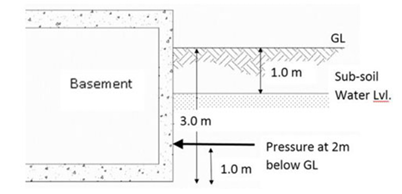
Group I Group II (P) Flat Slab (1) Thrust (Q) Long Column (2) Flutter (R) Arch (3) Punching Shear (S) Tensile Fabric (4) Buckling (5) Moment A basement wall resists lateral pressure exerted by soil and water. The soil pressure amounts to $4.5 \text{ kN/m}^2$ for every metre of depth below Ground Level (GL). The sub-soil water level is $1.0 \text{ m}$ below GL and hydrostatic pressure of water is $9.8 \text{ kN/m}^2$ for every metre of depth below GL. The total lateral pressure (in $kN/m^2$, rounded off to one decimal place) exerted on the wall $2 \text{ m}$ below GL is______
- Slenderness ratio of a column is represented as:
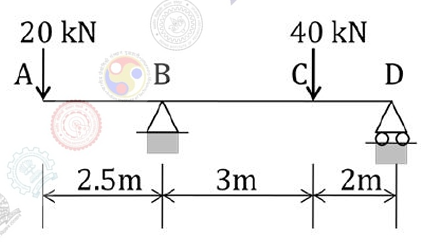
Value of bending moment in kN-m at point C for a beam as shown in the above figure is ________


