
Let $\Delta ABC$ be an isosceles triangle with the base $AB$ of length 8 units. Let $CD$ be a perpendicular of length 4 units drawn from the vertex $C$ onto the base $AB$ and $AC = BC$. Then, which of the following is the set of values of the angles (in degrees) $ CAB, ABC, BCA$ respectively?
Geometry Setup
We are given an isosceles triangle $\Delta ABC$ with base $AB$. The length of the base is $AB = 8$ units.
An altitude $CD$ is drawn from vertex $C$ to the base $AB$, with length $CD = 4$ units. Since $\Delta ABC$ is isosceles with $AC = BC$, the altitude $CD$ bisects the base $AB$. Therefore, point $D$ is the midpoint of $AB$.
This means $AD = DB = \frac{AB}{2} = \frac{8}{2} = 4$ units.
Analyzing Right-Angled Triangle ADC
Consider the triangle $\Delta ADC$. We know the following lengths:
- $AD = 4$ units
- $CD = 4$ units
- $\angle ADC = 90^\circ$ (since $CD$ is the altitude)
Since $AD = CD$, $\Delta ADC$ is an isosceles right-angled triangle.
Calculating Angles
In $\Delta ADC$, the sum of angles is $180^\circ$. We have:
$\angle CAD + \angle ACD + \angle ADC = 180^\circ$
Since $\Delta ADC$ is isosceles with $AD = CD$, the angles opposite these sides are equal:
$\angle CAD = \angle ACD$
Substituting into the sum of angles equation:
$\angle CAD + \angle CAD + 90^\circ = 180^\circ$
$2 \angle CAD = 180^\circ - 90^\circ$
$2 \angle CAD = 90^\circ$
$\angle CAD = 45^\circ$
Therefore, $\angle ACD = 45^\circ$.
Determining Angles of Triangle ABC
The angles of the triangle $\Delta ABC$ are:
- $\angle CAB$: This is the same angle as $\angle CAD$. So, $\angle CAB = 45^\circ$.
- $\angle ABC$: Since $\Delta ABC$ is isosceles with base $AB$, the base angles are equal. $\angle ABC = \angle CAB$. So, $\angle ABC = 45^\circ$.
- $\angle BCA$: This is the vertex angle. The sum of angles in $\Delta ABC$ is $180^\circ$. $\angle BCA = 180^\circ - (\angle CAB + \angle ABC)$ $\angle BCA = 180^\circ - (45^\circ + 45^\circ)$ $\angle BCA = 180^\circ - 90^\circ$ $\angle BCA = 90^\circ$
The set of angles is $\angle CAB, \angle ABC, \angle BCA = 45^\circ, 45^\circ, 90^\circ$.
Important Questions from Mensuration and Geometry
The city of Atlantis was crafted by the God of the seas, Poseidon. It was made of alternating concentric circular rings of land (shaded) and water (not shaded) as represented in the figure (not to scale). The radius of Inner Island was 2.5 stades (a unit of length used in ancient Greece). The water surrounding Inner Island was one stade wide (length AB). This was surrounded by two pairs of alternating rings of land and water. The first pair of land and water was two stades wide each (lengths BC and CD), and the outer pair is three stades wide each (lengths DE and EF).
The ratio of the surface area of the land to that of the water in the city of Atlantis is _________ (round off to two decimal places).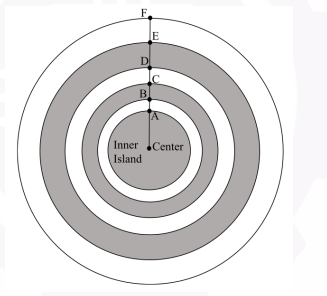
In the given figure, $P, Q$, and $R$ are three points on a circle of radius 10 cm with $O$ as its center, $\overline{PQ} = \overline{RQ}$, and $\angle PQR = 45^\circ$. The figure is representative.
The area of the shaded region $PQRO$ is ______________ cm$^2$.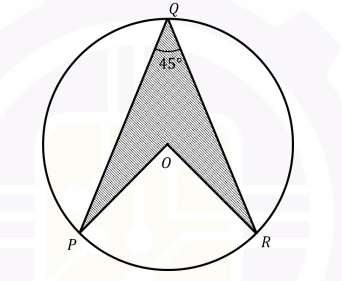
- A straight line $y = x - 1$ intersects a circle with center at $x = 1, y = 1$ and radius of magnitude 1 at two points. The length of the chord formed by this intersection is _______. (rounded off to three decimal places)
- The shell of a hollow spherical nanoparticle has a uniform thickness of 3 nanometers (nm). The outer radius of the nanoparticle is 5 nm. The ratio of the volume of the shell to the volume of the hollow core is ________
(Round off to one decimal place) - The volume of a sphere of diameter 1 unit is ______ than the volume of a cube of side 1 unit.


