
Kirchhoff's Laws & Energy Conservation
The Law of Conservation of Energy is a fundamental principle stating that energy cannot be created or destroyed, only converted from one form to another. The total energy within an isolated system remains constant.
Kirchhoff's Laws Basis
Kirchhoff's laws are essential for analyzing electrical circuits and are directly linked to conservation principles:
- Kirchhoff's Current Law (KCL): This law relates to the conservation of electric charge. It states that the sum of currents entering a junction must equal the sum of currents leaving it.
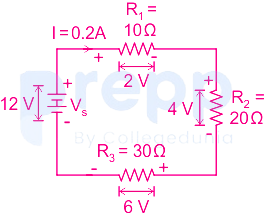
- Kirchhoff's Voltage Law (KVL): This law is a direct application of the Law of Conservation of Energy. It states that the sum of the voltage drops around any closed loop in a circuit must equal the sum of the voltage rises (e.g., from voltage sources). This means that the total energy gained or lost by charges moving around a closed loop is zero, reflecting energy conservation.
Why Other Laws Are Not the Basis
Other laws mentioned are related but not the primary basis for energy conservation in this context:
- Ohm's Law (V=IR) describes the relationship between voltage, current, and resistance but doesn't fundamentally express energy conservation itself.
- Faraday's Laws deal with electromagnetic induction and are related to energy conversion between electrical and magnetic forms, but KVL is a more direct application of the general energy conservation principle in circuits.
- Fleming's Rules relate to the direction of magnetic force, field, and current/motion, based on electromagnetism.
Therefore, Kirchhoff's laws, specifically KVL, serve as the basis for applying the Law of Conservation of Energy in electrical circuit analysis.
Similar Questions
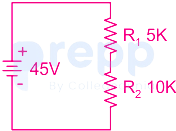
In the path given below, what is the voltage across R1 resistor?
Which among the following laws is shown in the given figure?
- According to Kirchoff's current law,:
- Kirchhoffs first rule of any junction of several circuit elements in an electric circuit is based on the law of conservation of:
Important Questions from Kirchhoff's Laws
______ finds the voltage potentials at different nodes that provide a common connection for two or more circuit components in a circuit.
How many equations are necessary to solve a circuit with two principal nodes?
A 40 Ω resistor is in parallel with an 80 Ω resistor. Current in the 40 Ω resistor is 6 A. How will you add a third resistor and what will be its value if the line-current is to be 10 A?
Kirchoff's first law states that at a junction in an electric circuit -
Kirchhoff's current law is based on the conservation of



