
Kirchhoff's Current Law Explained
Kirchhoff's Current Law (KCL), also known as the junction rule or Kirchhoff's first law, is a fundamental principle governing electric circuits. It is based on the principle of conservation of charge.
KCL Statement
The law states that for any electrical network, the algebraic sum of currents entering any junction (node) must be equal to the algebraic sum of currents leaving that junction.
In simpler terms, whatever current flows into a connection point must also flow out of it.
Mathematical Representation
KCL can be expressed mathematically. If we consider all currents entering a node as positive and all currents leaving the node as negative, the sum is zero:
$ \sum_{k=1}^{n} I_k = 0 $
Where '$I_k$' represents the current in the $k$-th branch connected to the node, and '$n$' is the total number of branches at that node. Alternatively, it can be stated as:
$ \sum I_{\text{entering}} = \sum I_{\text{leaving}} $
Analysis of Options
- Option 1: This option accurately describes Kirchhoff's Current Law. The total current flowing into a node must equal the total current flowing out of it.
- Option 2: This describes Kirchhoff's Voltage Law (KVL), which deals with the sum of voltage drops and rises in a closed loop, not currents at a node.
- Option 3: This is a statement related to Ohm's Law, which defines the relationship between voltage, current, and resistance in a component ($V = IR$).
- Option 4: This statement is incorrect. While KCL deals with currents at a node, the sum of currents in a loop is not necessarily zero; KVL deals with the sum of voltages in a loop.
Similar Questions
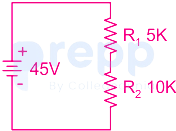
In the path given below, what is the voltage across R1 resistor?
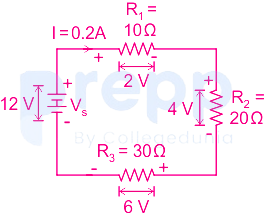
Which among the following laws is shown in the given figure?
- Law of conservation of Energy is the basis for ________ law.
- Kirchhoffs first rule of any junction of several circuit elements in an electric circuit is based on the law of conservation of:
Important Questions from Kirchhoff's Laws
______ finds the voltage potentials at different nodes that provide a common connection for two or more circuit components in a circuit.
How many equations are necessary to solve a circuit with two principal nodes?
A 40 Ω resistor is in parallel with an 80 Ω resistor. Current in the 40 Ω resistor is 6 A. How will you add a third resistor and what will be its value if the line-current is to be 10 A?
Kirchoff's first law states that at a junction in an electric circuit -
Kirchhoff's current law is based on the conservation of



