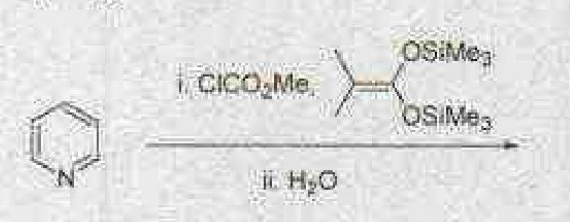
Understanding the Reaction Pathway
This question involves a multi-step organic synthesis reaction starting with isoquinoline. Let's break down the reaction sequence step-by-step:
Step 1: Reaction of Isoquinoline with Benzoyl Chloride
Isoquinoline, a heterocyclic aromatic compound, reacts with benzoyl chloride (PhCOCl). Benzoyl chloride acts as an acylating agent. The nitrogen atom in the isoquinoline ring is nucleophilic and attacks the electrophilic carbonyl carbon of benzoyl chloride. This results in the formation of an N-acyl isoquinolinium salt.
Chemical Representation:
$Isoquinoline + PhCOCl → [N-Benzoylisochinolinium]⁺ Cl⁻$
Step 2: Reaction with Potassium Cyanide (KCN)
The N-acyl isoquinolinium salt formed in the first step is then treated with potassium cyanide (KCN). The cyanide ion ($CN⁻$) acts as a nucleophile. It attacks the C1 position (the carbon adjacent to the nitrogen in the pyridine ring) of the isoquinolinium system. This addition reaction leads to the formation of a 1,2-dihydroisoquinoline derivative, specifically a Reissert compound.
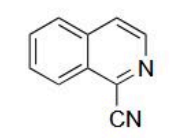
The resulting intermediate is 1-benzoyl-1,2-dihydroisoquinoline-1-carbonitrile. This structure corresponds to the image provided in Option 1.
Chemical Representation:
$[N-Benzoylisochinolinium]⁺ Cl⁻ + KCN → 1-Benzoyl-1,2-dihydroisoquinoline-1-carbonitrile + KCl$
Structure (Option 1):
Step 3: Heating with Aqueous Sodium Hydroxide (NaOH)
The final step involves heating the Reissert compound (formed in Step 2) with aqueous sodium hydroxide (aq. NaOH). Typically, under these conditions, the Reissert compound undergoes hydrolysis. The benzoyl group is removed, and the nitrile group is hydrolyzed to a carboxylic acid group, yielding isoquinoline-1-carboxylic acid. The structure shown in Option 1 represents the Reissert compound formed before this final hydrolysis step.
The overall reaction sequence is characteristic of the synthesis of Reissert compounds.
Summary of the Reaction
The transformation involves the acylation of isoquinoline, followed by nucleophilic addition of cyanide to form the Reissert compound.
Key Reactants: Isoquinoline, Benzoyl Chloride (PhCOCl), Potassium Cyanide (KCN)
Intermediate Product: 1-Benzoyl-1,2-dihydroisoquinoline-1-carbonitrile (Matches Option 1)
Final Step Reagent: Aqueous NaOH (aq. NaOH)
| Step | Reagents | Product Type |
|---|---|---|
| 1 | Benzoyl Chloride (PhCOCl) | N-Acyl Isoquinolinium Salt |
| 2 | Potassium Cyanide (KCN) | Reissert Compound (1-Benzoyl-1,2-dihydroisoquinoline-1-carbonitrile) |
| 3 | Aqueous NaOH (heat) | Isoquinoline-1-carboxylic acid (via hydrolysis of Reissert compound) |
Important Questions from Heterocyclic Compounds
- Compound A on Hofmann exhaustive N-methylation procedure (involving two cycles), followed by ozonolysis (i. $O_3$; ii. $Me_2S$) gives benzaldehyde, formaldehyde and 2,2-dimethylpropanedial. The structure of A is
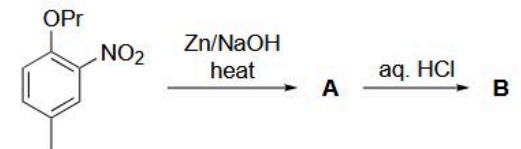
The major products A and B formed in the following reaction sequence are:
- The major product formed in the reaction of indole with NaNH$_2$ and PhSO$_2$Cl is
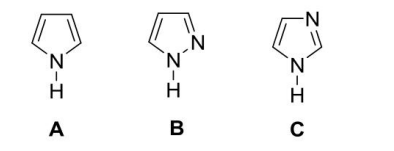
The correct order of basicity for the following heterocycles is
The major product formed in the following reaction is