
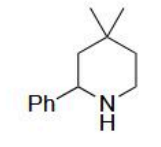
Identifying Compound A via Chemical Reactions
This question requires us to determine the structure of Compound A by analyzing the products obtained after performing Hofmann exhaustive N-methylation followed by ozonolysis.
Understanding the Reaction Sequence
The key steps are:
- Hofmann Exhaustive N-methylation: This reaction converts an amine into a quaternary ammonium salt by reacting it with an excess methylating agent, typically methyl iodide ($CH_3I$). The process involves adding methyl groups to the nitrogen atom until it forms four bonds, resulting in a positive charge.
- Ozonolysis: This step uses ozone ($O_3$) followed by dimethyl sulfide ($Me_2S$). While typically used to cleave carbon-carbon double bonds, in this context, it acts on the quaternary ammonium salt intermediate, likely cleaving the bonds attached to the nitrogen atom.
Interpreting the Reaction Products
The reaction sequence yields the following products:
- Benzaldehyde ($C_6H_5CHO$)
- Formaldehyde ($HCHO$)
- 2,2-dimethylpropanedial ($CHO-C(CH_3)_2-CHO$)
These products provide clues about the structure of Compound A. The cleavage of the quaternary ammonium salt typically breaks the bonds connected to the nitrogen. The products suggest the quaternary nitrogen was bonded to fragments corresponding to:
- A phenyl group ($C_6H_5$), which leads to benzaldehyde ($C_6H_5CHO$).
- A methyl group ($CH_3$), which leads to formaldehyde ($HCHO$).
- A more complex group that results in 2,2-dimethylpropanedial ($CHO-C(CH_3)_2-CHO$). This structure contains a central carbon atom bonded to two methyl groups ($C(CH_3)_2$).
Evaluating Option 1: N-phenylpiperidine
Let's assume Compound A is N-phenylpiperidine, as suggested by Option 1.
Structure of N-phenylpiperidine
N-phenylpiperidine is a tertiary amine where a phenyl group ($C_6H_5$) is attached to the nitrogen atom, and the nitrogen is part of a six-membered saturated ring (piperidine, $C_5H_{10}$). Its formula is $C_6H_5-N(C_5H_{10})$.
Reaction Pathway
- N-methylation: Reacting N-phenylpiperidine with a methylating agent ($CH_3I$) forms the quaternary ammonium salt. Since N-phenylpiperidine is a tertiary amine, one methylation step is sufficient to form the quaternary salt:
$C_6H_5-N(C_5H_{10}) \xrightarrow{CH_3I} [C_6H_5-N^+(CH_3)(C_5H_{10})]I^- $
The quaternary nitrogen atom in this salt is bonded to three distinct groups: the phenyl group ($C_6H_5$), a methyl group ($CH_3$), and the piperidine ring system (connected at two alpha-carbon positions, represented collectively as $C_5H_{10}$). - Ozonolysis/Cleavage: According to the problem, this quaternary salt breaks down to yield benzaldehyde, formaldehyde, and 2,2-dimethylpropanedial.
- The phenyl group ($C_6H_5$) attached to the nitrogen is consistent with the formation of benzaldehyde ($C_6H_5CHO$).
- The methyl group ($CH_3$) attached to the nitrogen is consistent with the formation of formaldehyde ($HCHO$).
- The piperidine ring fragment ($C_5H_{10}$) must be responsible for forming 2,2-dimethylpropanedial ($CHO-C(CH_3)_2-CHO$). While the specific mechanism by which the saturated piperidine ring cleaves to form this specific dialdehyde isn't straightforward, the problem implies this transformation occurs.
Considering that the phenyl and methyl groups account for two of the products, N-phenylpiperidine fits the reaction outcome described in the question.
Conclusion on Structure
Based on the analysis of the reaction products and the fragments typically generated during the cleavage of quaternary ammonium salts formed via Hofmann exhaustive N-methylation, N-phenylpiperidine (Option 1) is the most plausible structure for Compound A.
Important Questions from Heterocyclic Compounds
- The major product formed in the reaction of indole with NaNH$_2$ and PhSO$_2$Cl is
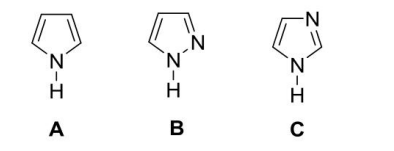
The correct order of basicity for the following heterocycles is
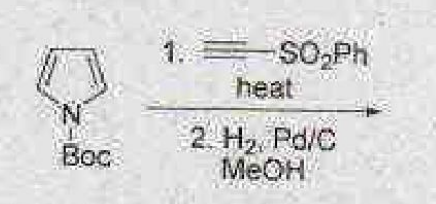
The major product formed in the following reaction is
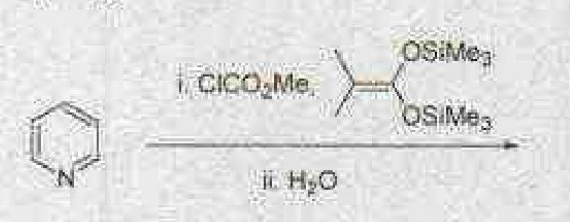
The major heterocyclic compound formed in the following reaction is
The mechanism of acid catalyzed hydrolysis of benzonitrile involves


