
FCC Crystal Diffraction: Second Reflection Angle Calculation
The problem requires finding the Bragg angle for the second reflection in an FCC crystal, given the first reflection occurs at $\theta_1 = 30^\circ$. We need to use Bragg's Law and knowledge of FCC diffraction rules.
Applying Bragg's Law
Bragg's Law is stated as:
$ n\lambda = 2d \sin\theta $
Where '$n$' is the order of reflection, '$\lambda$' is the X-ray wavelength, '$d$' is the interplanar spacing, and '$\theta$' is the Bragg angle.
For the first reflection ($n=1$) and the second reflection ($n=1$, assuming the lowest angle reflections are first order), we have:
$ \lambda = 2d_1 \sin\theta_1 $
$ \lambda = 2d_2 \sin\theta_2 $
Equating these implies:
$ d_1 \sin\theta_1 = d_2 \sin\theta_2 $
This can be rearranged to find the second angle:
$ \sin\theta_2 = \frac{d_1}{d_2} \sin\theta_1 $
FCC Reflection Indices and d-spacing
The interplanar spacing '$d$' for a cubic system is given by:
$ d = \frac{a}{\sqrt{h^2+k^2+l^2}} $
Where '$a$' is the lattice parameter and (hkl) are the Miller indices.
The ratio $\frac{d_1}{d_2}$ is therefore:
$ \frac{d_1}{d_2} = \frac{\sqrt{h_2^2+k_2^2+l_2^2}}{\sqrt{h_1^2+k_1^2+l_1^2}} $
For FCC crystals, allowed reflections correspond to planes where h, k, and l are all even or all odd. The sequence of allowed reflections by increasing angle (decreasing d-spacing) starts with (111), then (200), then (220), etc.
- First reflection: Corresponds to the (111) plane. $h_1^2+k_1^2+l_1^2 = 1^2+1^2+1^2 = 3$.
- Second reflection: Corresponds to the (200) plane. $h_2^2+k_2^2+l_2^2 = 2^2+0^2+0^2 = 4$.
So, the ratio of d-spacings is:
$ \frac{d_1}{d_2} = \frac{\sqrt{4}}{\sqrt{3}} = \frac{2}{\sqrt{3}} $
Calculating $\theta_2$
Substitute the d-spacing ratio and $\theta_1 = 30^\circ$ into the equation for $\sin\theta_2$:
$ \sin\theta_2 = \left(\frac{2}{\sqrt{3}}\right) \sin(30^\circ) $
Since $\sin(30^\circ) = 0.5$:
$ \sin\theta_2 = \frac{2}{\sqrt{3}} \times 0.5 = \frac{1}{\sqrt{3}} $
Calculate the value of $\sin\theta_2$:
$ \sin\theta_2 \approx 0.57735 $
Find the angle $\theta_2$:
$ \theta_2 = \arcsin\left(\frac{1}{\sqrt{3}}\right) \approx 35.264^\circ $
Final Answer
Rounding the result to one decimal place, the Bragg angle for the second reflection is:
$ \theta_2 \approx 35.3^\circ $
Important Questions from Crystallography Stereographic Projection
- Residual stress present in a material can be determined by which one of the following techniques:
A schematic of X-ray diffraction pattern of a single phase cubic polycrystal is given below. The miller indices of peak A is
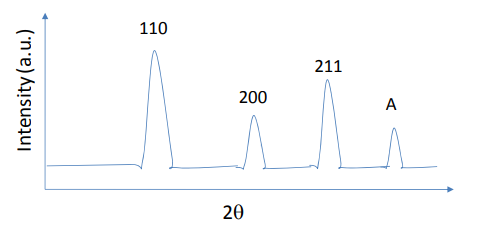
In a powder diffraction experiment on BCC iron, the first peak occurs at $2\theta = 68.7^\circ$. The wavelength of X-rays is ________ (in nm to three decimal places).
Given: The lattice parameter of iron = $0.287 \text{ nm}$
- For an FCC metal, the ratio of interplanar spacing obtained from the first two peaks of the X-ray diffraction pattern is
X-ray diffraction pattern from an elemental metal with a FCC crystal structure shows the first peak at a Bragg angle $\theta = 24.65^\circ$. The lattice parameter of this metal is ____________ nm.
Given, wavelength of the X-ray used is $0.1543$ nm.


