
X-ray diffraction pattern from an elemental metal with a FCC crystal structure shows the first peak at a Bragg angle $\theta = 24.65^\circ$. The lattice parameter of this metal is ____________ nm.
Given, wavelength of the X-ray used is $0.1543$ nm.
Calculating FCC Lattice Parameter using X-ray Diffraction
This solution outlines the steps to determine the lattice parameter of an elemental metal with a Face-Centered Cubic (FCC) crystal structure using X-ray diffraction data.
Applying Bragg's Law
Bragg's Law relates the wavelength of X-rays ($\lambda$), the distance between atomic planes ($d$), the Bragg angle ($\theta$), and the order of diffraction ($n$):
$n\lambda = 2d\sin\theta$
For the first peak ($n=1$), we can rearrange the formula to find the interplanar spacing ($d$):
$d = \frac{n\lambda}{2\sin\theta}$
Given:
- Wavelength ($\lambda$) = $0.1543$ nm
- Bragg angle ($\theta$) = $24.65^\circ$
- Order ($n$) = 1
First, calculate $\sin\theta$:
$\sin(24.65^\circ) \approx 0.4171$
Now, calculate $d$:
$d = \frac{1 \times 0.1543 \text{ nm}}{2 \times 0.4171} \approx \frac{0.1543 \text{ nm}}{0.8342} \approx 0.18497 \text{ nm}$
Relating Interplanar Spacing to Lattice Parameter for FCC
For an FCC crystal structure, the interplanar spacing ($d$) for a set of Miller indices ($hkl$) is given by:
$d = \frac{a}{\sqrt{h^2+k^2+l^2}}$
where $a$ is the lattice parameter.
The first diffraction peak in an FCC pattern corresponds to the (111) planes because they represent the smallest allowed value for $\sqrt{h^2+k^2+l^2}$.
Therefore, for the (111) plane:
$d_{(111)} = \frac{a}{\sqrt{1^2+1^2+1^2}} = \frac{a}{\sqrt{3}}$
Calculating the Lattice Parameter
Rearrange the formula to solve for $a$:
$a = d_{(111)}\sqrt{3}$
Substitute the calculated value of $d$:
$a \approx 0.18497 \text{ nm} \times \sqrt{3}$
$a \approx 0.18497 \text{ nm} \times 1.732 \approx 0.3203 \text{ nm}$
Rounding to two decimal places, the lattice parameter is $0.32$ nm.
Important Questions from Crystallography Stereographic Projection
- Residual stress present in a material can be determined by which one of the following techniques:
A schematic of X-ray diffraction pattern of a single phase cubic polycrystal is given below. The miller indices of peak A is
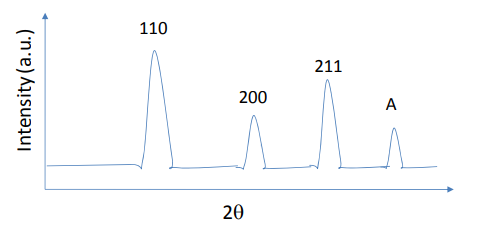
In a powder diffraction experiment on BCC iron, the first peak occurs at $2\theta = 68.7^\circ$. The wavelength of X-rays is ________ (in nm to three decimal places).
Given: The lattice parameter of iron = $0.287 \text{ nm}$
- For an FCC metal, the ratio of interplanar spacing obtained from the first two peaks of the X-ray diffraction pattern is
- If d is the inter-planar spacing of the planes {h k l}, the inter-planar spacing of the planes {nh nk nl}, n being an integer, is


