
Residual Stress Determination Techniques
Residual stresses within a material can be accurately determined using X-ray Diffraction (XRD). This technique works by measuring the minute changes in the crystal lattice spacing of the material. These changes are directly related to the strain induced by residual stresses. By analyzing the shifts in the diffraction peak positions, the magnitude and direction of residual stresses can be calculated. XRD is often preferred because it is a non-destructive method.
Why Other Techniques Are Less Suitable
- Tensile Testing: This method measures the material's response to applied external forces (tension) and determines properties like yield strength and ultimate tensile strength. It does not directly measure inherent residual stresses.
- Thermo-Gravimetric Analysis (TGA): TGA measures the change in mass of a sample as a function of temperature or time. It is primarily used for analyzing thermal stability, decomposition, and composition, not mechanical stresses.
- Optical Microscopy: This technique is used to observe the material's microstructure, surface topography, and defects. While microstructural features can sometimes be influenced by stress, microscopy itself does not quantify residual stress levels.
Therefore, X-ray Diffraction (XRD) is the most appropriate technique among the choices for determining residual stress.
Important Questions from Crystallography Stereographic Projection
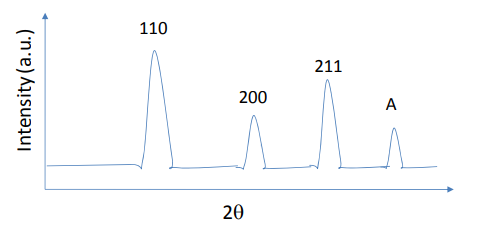
A schematic of X-ray diffraction pattern of a single phase cubic polycrystal is given below. The miller indices of peak A is
In a powder diffraction experiment on BCC iron, the first peak occurs at $2\theta = 68.7^\circ$. The wavelength of X-rays is ________ (in nm to three decimal places).
Given: The lattice parameter of iron = $0.287 \text{ nm}$
- For an FCC metal, the ratio of interplanar spacing obtained from the first two peaks of the X-ray diffraction pattern is
X-ray diffraction pattern from an elemental metal with a FCC crystal structure shows the first peak at a Bragg angle $\theta = 24.65^\circ$. The lattice parameter of this metal is ____________ nm.
Given, wavelength of the X-ray used is $0.1543$ nm.- If d is the inter-planar spacing of the planes {h k l}, the inter-planar spacing of the planes {nh nk nl}, n being an integer, is


