
In the standard adjoining diagram, the measure of consumer surplus is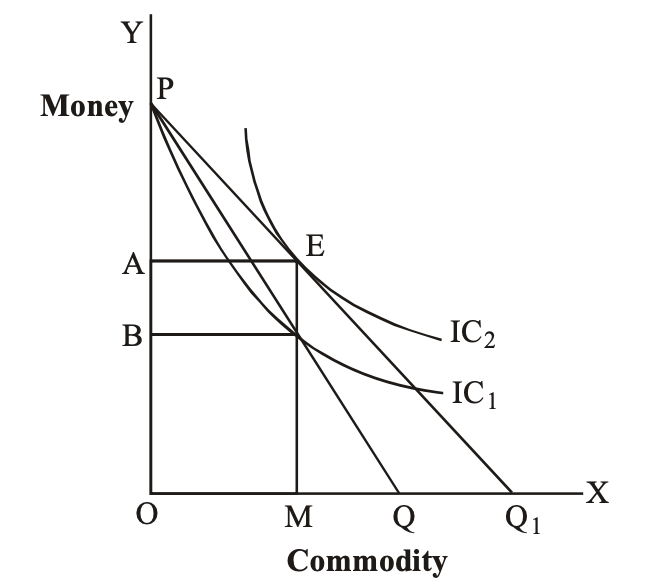
Consumer surplus is a measure in economics that reflects the difference between what consumers are willing to pay for a good or service versus what they actually do pay. It is essentially the area above the price level and below the demand curve.
Consider the diagram provided:
- The demand curve is typically represented by the line extending from point P downward.
- The consumer surplus is the area between the demand curve and the horizontal line representing the price level.
- Here, point A on the vertical axis represents the price level. The area AB between the price A, the demand curve at P, and the quantity axis at B is the consumer surplus.
- Therefore, the consumer surplus is the area AB in the given diagram.
Hence, the correct answer is option AB.
Important Questions from Consumer behaviour
Which one of the following is not the assumption for consumer behaviour based on the Ordinal Utility Theory?
Which one of the following expresses the tendency of consumers to interpret information in a way that fits one’s preconceptions in the consumer buying behaviour?
The concept of consumer surplus was propounded by __________.
Goods whose demand varies inversely with income are called ____ goods.
_____ have an income elasticity of demand of between 0 and +1.


