In the figure shown, PT and PAB are the tangent and the secant drawn to a circle; PT = 12 cm and PA = 8 cm, then AB is equal to: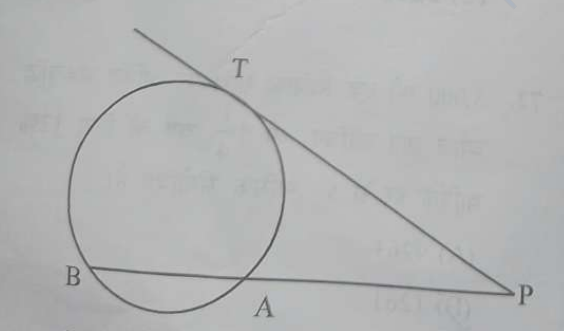
10 cm
By the tangent-secant theorem (power of a point), PT² = PA × PB. Substituting values gives 12² = 8 × PB, so PB = 18 cm. Since AB = PB − PA, AB = 18 − 8 = 10 cm. Note: the handwritten mark on this item in the source paper was faint and inconclusive, so this value follows the standard theorem.
Important Questions from Circles
The sum of the radius and diameter of a circle is 84 cm. What is the circumference of this circle?
The maximum area of a right-angled triangle inscribed in a circle of radius r is
The tangent at a point C of a circle and diameter AB when extended intersect at D, if ∠DCA = 110°, then ∠CBA is equal to
The equation of a circle with diameters are 2x - 3y + 12 = 0 and x + 4y - 5 = 0 and area of 154 sq. units is
The internal center of similitude of two circles $ (x - 1)^2 + (y - 3)^2 = 4 $ and $ (x + 5)^2 + (y - 9)^2 = 16 $ is