In the cyclization reaction given below, the most probable product formed is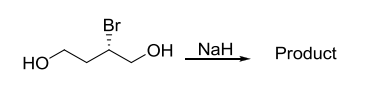
The given cyclization reaction involves an intramolecular nucleophilic substitution, where the alcohol (\( \text{OH} \)) group acts as a nucleophile to attack the electrophilic carbon attached to the bromine (\( \text{Br} \)) atom. This forms a cyclic ether through the elimination of bromide.
Let's analyze the steps:
- The reaction begins with the deprotonation of the hydroxyl group by sodium hydride (\( \text{NaH} \)), generating an alkoxide ion.
- The alkoxide ion, being a strong nucleophile, will attack the carbon atom bonded to the bromine on the same molecule.
- This intramolecular nucleophilic substitution (SN2 mechanism) results in the formation of an epoxide ring (a three-membered cyclic ether) by displacing the bromide ion.
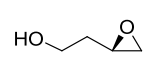
The most probable product is the epoxide formed by this cyclization process.
The reaction can be depicted as:
The correct option that represents the formed product is:
Conclusion: The correct product is the epoxide, as it follows the mechanism of intramolecular nucleophilic substitution where the deprotonated alcohol attacks the bromine-bearing carbon.
Important Questions from Organic Synthesis
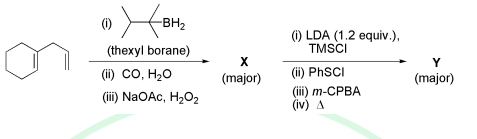
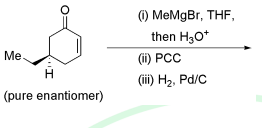
The major products X and Y formed in the following reaction sequences are
For the following reaction, the possible product(s) is/are
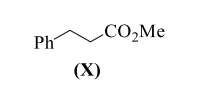
The reaction(s) that yield(s) X as the major product is (are)
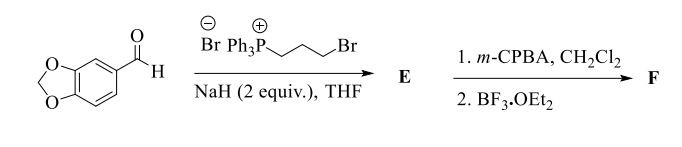
The major products E and F in the following reaction sequence are
Consider the following reaction sequence. The correct option(s) is (are)