
Plunge amount Plunge Direction 40 270 30 090 10 180 20 000
Identifying Early Fold Measurements in Superposed Folding
This question concerns identifying measurements related to early folds within an area exhibiting superposed folding that results in a dome and basin pattern. We are given that the late folds have $\text{E} - \text{W}$ vertical axial planes.
Understanding Axial Planes and Fold Axes
- An axial plane striking $\text{E} - \text{W}$ and being vertical implies that the fold axis associated with these late folds trends North-South (N-S).
- In dome and basin structures, superposition of two fold sets with axes oriented at high angles is typical. If the late folds have N-S axes, the early folds would ideally have axes oriented perpendicular to this, i.e., East-West (E-W).
- However, the provided fold hinge measurements (plunge and direction) must be analyzed directly.
Analyzing Fold Hinge Data
The provided measurements for fold hinges are:
- Measurement 1: Plunge $40^\circ$, Direction $270^\circ$ (West)
- Measurement 2: Plunge $30^\circ$, Direction $090^\circ$ (East)
- Measurement 3: Plunge $10^\circ$, Direction $180^\circ$ (South)
- Measurement 4: Plunge $20^\circ$, Direction $000^\circ$ (North)
The options group pairs of these measurements:
- Option 1: ($40^\circ-270^\circ$; $10^\circ - 180^\circ$)
- Option 2: ($30^\circ-090^\circ$; $20^\circ-000^\circ$)
- Option 3: ($10^\circ-180^\circ$; $30^\circ - 090^\circ$)
- Option 4: ($10^\circ-180^\circ$; $20^\circ-000^\circ$)
Determining Early Fold Characteristics
In the context of superposed folding, structures from the early phase are often characterized by less intense deformation or different orientations compared to later modifications. Observing the plunge values:
- The measurements $10^\circ$ (Direction $180^\circ$) and $20^\circ$ (Direction $000^\circ$) represent the shallowest plunges among the given data.
- These shallow plunges are often indicative of the earlier fold development. The later folding phases can modify these structures, potentially increasing plunge or changing orientation.
- Option 4 combines these two measurements with the shallowest plunges: ($10^\circ-180^\circ$; $20^\circ-000^\circ$).
Therefore, the measurements likely belonging to the early folds are those with the shallowest plunges.
Important Questions from Folds
The following figure shows the lower hemisphere, equal area plots of the poles to bedding surfaces. Which one of the following is the correct interpretation?
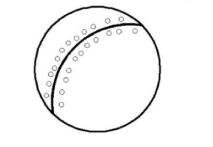
- The intersection of bedding surface with upright slaty cleavage surface occurs as horizontal lineation. Which one of the following is the most likely interpretation? The bedding surfaces are folded into
Figures A and B show two cross-sections of a folded sandstone bed.
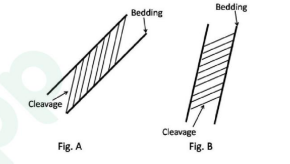
Which one of the following is the correct interpretation of the Figs. A and B?
Match the outcrop patterns of folds with corresponding types.
Outcrop Patterns Fold A. 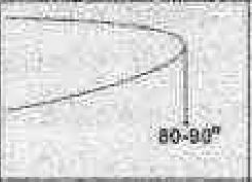
P. Plunging antiform B. 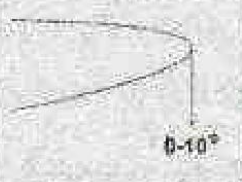
Q. Plunging synform C. 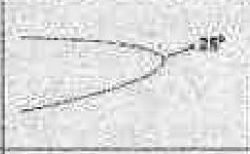
R. Reclined D. 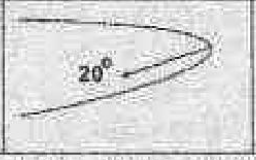
S. Recumbent - Which one of the following is the correct angle between the hinge line and the strike line of the axial plane in a reclined fold?


