
In a survey of 260 students in a school, 100 were listed as taking apple juice, 150 as taking orange juice, and 75 were listed as taking both apple as well as orange juice. Find how many students were taking neither apple juice nor orange juice.
85
To determine how many students were taking neither apple juice nor orange juice, we can use the principle of inclusion-exclusion in set theory. Let's define:
- Total number of students surveyed: \( N = 260 \)
- Students taking apple juice: \( A = 100 \)
- Students taking orange juice: \( O = 150 \)
- Students taking both apple and orange juice: \( A \cap O = 75 \)
The formula for finding the number of students taking either apple juice or orange juice (or both) is:
\[ |A \cup O| = |A| + |O| - |A \cap O| \]
Substituting the values, we get:
\[ |A \cup O| = 100 + 150 - 75 = 175 \]
This means 175 students were taking either apple juice or orange juice or both. To find the number of students taking neither, we subtract this from the total number of students:
\[ N - |A \cup O| = 260 - 175 = 85 \]
Therefore, 85 students were taking neither apple juice nor orange juice.
The correct answer is 85.
Important Questions from Venn Diagram Problems
In a group of 73 friends, 14 friends go to Gym and Karate classes both, whereas 7 friends neither go to Gym class nor to Karate class. If a total of 36 friends go to Gym class, then how many friends go to only Karate class?
In an examination 20% students failed in Mathematics and 15% failed in English. If 10% failed in both and those who passed in both numbered 300, then the total number of students who appeared in the examination was
In the following diagram, the 'circle' stands for 'soldiers', the 'square' stands for 'Indians', and the 'triangle' stands for 'singers'. The numbers given in the different segments represent persons belonging to that category.
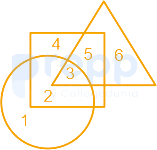
Which category is represented by the number '5'?
- In the following diagram, the circle stands for 'policemen', the square stands for 'sportspersons' and the 'triangle' stands for 'tax-payers' the numbers given in the different segments represent the number of persons in that category.
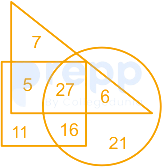
How many policemen are tax-payers but are NOT sportspersons?
Which of the following Venn diagrams represents the relationship between Lions, Deers and Carnivores?


