
Fed-Batch Calculation: Cell Concentration at 8 Hours
This problem involves calculating the cell concentration in a fed-batch culture at a specific time point (t=8 hours) under quasi steady-state conditions. We use the given substrate feed information and the yield coefficient to determine the amount of new cell mass produced.
Substrate Addition Rate
First, calculate the rate at which the substrate (glucose) is being added to the bioreactor:
- Feed concentration ($C_{s,feed}$) = 200 g$\cdot L^{-1}$
- Feed flow rate ($F_{feed}$) = 50 L$\cdot h^{-1}$
- Substrate addition rate = $F_{feed} \times C_{s,feed}$
- Substrate addition rate = $50 \, L \cdot h^{-1} \times 200 \, g \cdot L^{-1} = 10000 \, g \cdot h^{-1}$
Cell Mass Production
The yield coefficient ($Y_{x/s}$) relates the amount of cell mass produced to the amount of substrate consumed. Assuming the added substrate is primarily consumed for cell growth:
- Yield coefficient ($Y_{x/s}$) = 0.5 g cell mass$\cdot$g substrate$^{-1}$
- Rate of cell mass production = $Y_{x/s} \times (\text{Substrate addition rate})$
- Rate of cell mass production = $0.5 \, g/g \times 10000 \, g \cdot h^{-1} = 5000 \, g \cdot h^{-1}$
Calculate the total cell mass produced over 8 hours:
- Time ($t$) = 8 h
- Total cell mass produced = Rate of cell mass production $\times t$
- Total cell mass produced = $5000 \, g \cdot h^{-1} \times 8 \, h = 40000 \, g$
Total Cell Mass and Volume
Calculate the initial total cell mass and the final volume at t=8 h.
- Initial volume ($V_0$) = 600 L
- Initial cell concentration ($X_0$) = 20 g$\cdot L^{-1}$
- Initial cell mass = $X_0 \times V_0 = 20 \, g \cdot L^{-1} \times 600 \, L = 12000 \, g$
- Final volume ($V$) = $V_0 + (F_{feed} \times t)$
- Final volume ($V$) = $600 \, L + (50 \, L \cdot h^{-1} \times 8 \, h) = 600 \, L + 400 \, L = 1000 \, L$
Final Cell Concentration
Calculate the total cell mass at t=8 h and then the final cell concentration.
- Total cell mass at t=8 h = Initial cell mass + Total cell mass produced
- Total cell mass at t=8 h = $12000 \, g + 40000 \, g = 52000 \, g$
- Final cell concentration ($X$) = Total cell mass at t=8 h / Final volume ($V$)
- Final cell concentration ($X$) = $52000 \, g / 1000 \, L = 52 \, g \cdot L^{-1}$
The cell concentration at t=8 h is 52 g$\cdot L^{-1}$.
Important Questions from Batch Fed Batch and Continuous Processes
- Under complete cell washout condition in a chemostat with sterile feed, which of the following statements is/are correct?
A fed batch process is running at quasi-steady state with respect to substrate and biomass concentration. At $2 \text{ h}$, the culture volume is $500 \text{ L}$ with a constant sterile inlet feed at $50 \text{ L } h^{-1}$ of glucose. The culture kinetic parameters $ \mu_m$ and $K_s$ are $0.2 \text{ } h^{-1}$ and $0.1 \text{ } g \text{ } L^{-1}$, respectively.
The substrate concentration in the reactor will be ________ $g \text{ } L^{-1}$ (rounded off to one decimal place).
The following schematic diagram shows a chemostat with cell recycle
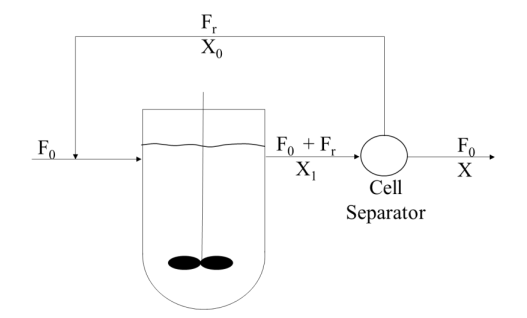
where $F_0$ and $F_r$ are the volumetric flow rates (in $L.h^{-1}$) of feed and recycle streams, respectively. $X_1$, $X_0$ and $X$ are the cell concentrations (in $g.L^{-1}$) in the reactor, recycle-stream and product-stream, respectively. If $\frac{X_0}{X_1}=1.5$, $\frac{F_r}{F_0}=0.7$ and $X_1$ is $7.3 g.L^{-1}$, the value of $X$ (in $g.L^{-1}$, rounded off to one decimal place) is ________
A $2 \text{ L}$ bioreactor is being operated as a chemostat, at a flow rate of $0.8 \text{ L/h}$ and sterile feed of $10 \text{ g/L}$ substrate. The bacterial growth follows Monod kinetics at a maximum specific growth rate of $0.6 \text{ h}^{-1}$ with a Monod constant of $0.5 \text{ g/L}$ and a biomass yield coefficient of $0.4 \text{ g/g}$. The exit biomass concentration is __________ $\text{g/L}$.
(Round off to one decimal place)
- The amount of biomass in a reactor at the end of the batch process is 50 g. Fed- batch operation is initiated by feeding the substrate solution at a constant rate of $1 \text{ L h}^{-1}$. The concentration of substrate in the feed is $50 \text{ g L}^{-1}$. The maximum biomass yield ($Y_{XS}^M$) is $0.4 \frac{\text{g biomass}}{\text{g substrate}}$. Assuming the system is at quasi-steady state, the maximum amount of biomass after 5 h of feeding is ________________ g.


