
Biomass Calculation in Fed-Batch Reactor
This solution details the calculation of the maximum biomass amount in a fed-batch reactor operating under quasi-steady state (QSS) conditions.
Understanding Quasi-Steady State (QSS)
The quasi-steady state (QSS) assumption simplifies fed-batch operations. It implies that key concentrations, such as biomass ($X$) and substrate ($S$), remain relatively constant over the period of interest. In this context, it allows us to assume a constant rate of biomass production based on the substrate feeding rate and the maximum biomass yield ($Y_{XS}^M$).
Calculating Final Biomass Amount
We are given:
- Initial biomass amount: $X_{amount, 0} = 50 \text{ g}$
- Substrate feed rate: $F_{in} = 1 \text{ L h}^{-1}$
- Substrate concentration in feed: $S_{in} = 50 \text{ g L}^{-1}$
- Maximum biomass yield: $Y_{XS}^M = 0.4 \frac{\text{g biomass}}{\text{g substrate}}$
- Time duration: $t = 5 \text{ h}$
Step 1: Calculate the Rate of Substrate Feeding
The rate at which substrate is supplied to the reactor determines the potential for biomass production.
Substrate feed rate $= F_{in} \times S_{in}$
Substrate feed rate $= 1 \text{ L h}^{-1} \times 50 \text{ g L}^{-1} = 50 \text{ g substrate h}^{-1}$
Step 2: Calculate the Biomass Production Rate
Under QSS and using the maximum yield, the rate of biomass production is directly proportional to the rate of substrate consumption.
Biomass production rate $= Y_{XS}^M \times (\text{Substrate feed rate})$
Biomass production rate $= 0.4 \frac{\text{g biomass}}{\text{g substrate}} \times 50 \text{ g substrate h}^{-1} = 20 \text{ g biomass h}^{-1}$
Step 3: Calculate the Total Biomass Produced
The total amount of new biomass generated during the feeding period is the production rate multiplied by the time.
Total biomass produced $= \text{Biomass production rate} \times t$
Total biomass produced $= 20 \text{ g h}^{-1} \times 5 \text{ h} = 100 \text{ g}$
Step 4: Calculate the Final Biomass Amount
The final amount of biomass is the sum of the initial biomass and the biomass produced during the fed-batch operation.
Final biomass amount $= X_{amount, 0} + \text{Total biomass produced}$
Final biomass amount $= 50 \text{ g} + 100 \text{ g} = 150 \text{ g}$
Important Questions from Batch Fed Batch and Continuous Processes
- Under complete cell washout condition in a chemostat with sterile feed, which of the following statements is/are correct?
A fed batch process is running at quasi-steady state with respect to substrate and biomass concentration. At $2 \text{ h}$, the culture volume is $500 \text{ L}$ with a constant sterile inlet feed at $50 \text{ L } h^{-1}$ of glucose. The culture kinetic parameters $ \mu_m$ and $K_s$ are $0.2 \text{ } h^{-1}$ and $0.1 \text{ } g \text{ } L^{-1}$, respectively.
The substrate concentration in the reactor will be ________ $g \text{ } L^{-1}$ (rounded off to one decimal place).
The following schematic diagram shows a chemostat with cell recycle
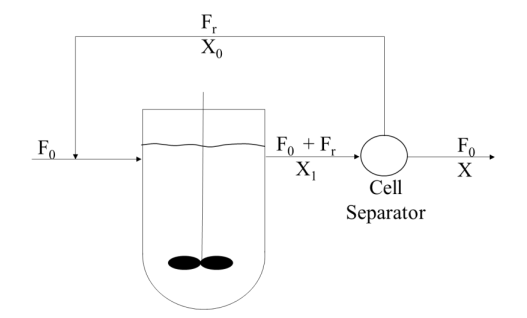
where $F_0$ and $F_r$ are the volumetric flow rates (in $L.h^{-1}$) of feed and recycle streams, respectively. $X_1$, $X_0$ and $X$ are the cell concentrations (in $g.L^{-1}$) in the reactor, recycle-stream and product-stream, respectively. If $\frac{X_0}{X_1}=1.5$, $\frac{F_r}{F_0}=0.7$ and $X_1$ is $7.3 g.L^{-1}$, the value of $X$ (in $g.L^{-1}$, rounded off to one decimal place) is ________
A $2 \text{ L}$ bioreactor is being operated as a chemostat, at a flow rate of $0.8 \text{ L/h}$ and sterile feed of $10 \text{ g/L}$ substrate. The bacterial growth follows Monod kinetics at a maximum specific growth rate of $0.6 \text{ h}^{-1}$ with a Monod constant of $0.5 \text{ g/L}$ and a biomass yield coefficient of $0.4 \text{ g/g}$. The exit biomass concentration is __________ $\text{g/L}$.
(Round off to one decimal place)
- In a chemostat with a dilution rate of $0.8 \text{ h}^{-1}$, the steady state biomass concentration and the specific product formation rate are $8 \text{ mol m}^{-3}$ and $0.2 \text{ (mol product) (mol biomass)}^{-1} \text{ h}^{-1}$, respectively. The steady state product concentration in $mol \text{ m}^{-3}$ is ________


