
Chemostat Washout Conditions Explained
Understanding the behavior of a chemostat under specific conditions is crucial. The question describes a scenario with:
- Sterile Feed: The incoming medium contains nutrients but no viable microorganisms.
- Complete Cell Washout: The rate at which cells are removed from the reactor exceeds their growth rate. This occurs when the dilution rate ($D$) is greater than the maximum specific growth rate ($\mu_{max}$) of the cells.
Biomass Concentration During Washout
When complete cell washout occurs ($D > \mu$), the net growth rate of the biomass is negative. Cells are flushed out of the reactor faster than they can reproduce.
Consequently, the biomass concentration ($X$) in the reactor decreases over time and approaches zero. Statement 1 is incorrect as biomass is minimal, not maximum, during washout.
Substrate Concentration Dynamics
Substrate consumption is primarily driven by cell growth. The rate of substrate consumption is typically modeled as being proportional to both the biomass concentration ($X$) and the specific growth rate ($\mu$).
In the case of complete cell washout:
- The biomass concentration ($X$) is very low, tending towards zero.
- As a result, the rate of substrate consumption ($\mu X$) becomes negligible.
For a chemostat with sterile feed, the substrate mass balance equation simplifies when consumption is minimal. The rate at which substrate enters the reactor must balance the rate at which it leaves, as biological consumption is negligible.
Therefore:
- The substrate concentration in the inlet stream ($S_{in}$) is essentially equal to the substrate concentration in the exit stream ($S_{out}$).
- Statements 2 ($S_{out} < S_{in}$) and 4 ($S_{out} = 0$) are incorrect because negligible consumption means the concentration doesn't decrease significantly, nor does it reach zero due to consumption.
- Statement 3 ($S_{out} = S_{in}$) correctly describes the situation where minimal substrate is consumed due to the lack of active biomass.
Final Conclusion on Chemostat Washout
Under complete cell washout conditions with a sterile feed, the chemostat operates with minimal cell growth and consequently, minimal substrate consumption. This results in the substrate concentration leaving the reactor being virtually identical to that entering with the feed.
Important Questions from Batch Fed Batch and Continuous Processes
A fed batch process is running at quasi-steady state with respect to substrate and biomass concentration. At $2 \text{ h}$, the culture volume is $500 \text{ L}$ with a constant sterile inlet feed at $50 \text{ L } h^{-1}$ of glucose. The culture kinetic parameters $ \mu_m$ and $K_s$ are $0.2 \text{ } h^{-1}$ and $0.1 \text{ } g \text{ } L^{-1}$, respectively.
The substrate concentration in the reactor will be ________ $g \text{ } L^{-1}$ (rounded off to one decimal place).
The following schematic diagram shows a chemostat with cell recycle
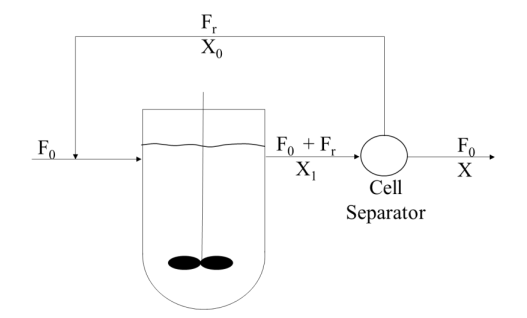
where $F_0$ and $F_r$ are the volumetric flow rates (in $L.h^{-1}$) of feed and recycle streams, respectively. $X_1$, $X_0$ and $X$ are the cell concentrations (in $g.L^{-1}$) in the reactor, recycle-stream and product-stream, respectively. If $\frac{X_0}{X_1}=1.5$, $\frac{F_r}{F_0}=0.7$ and $X_1$ is $7.3 g.L^{-1}$, the value of $X$ (in $g.L^{-1}$, rounded off to one decimal place) is ________
A $2 \text{ L}$ bioreactor is being operated as a chemostat, at a flow rate of $0.8 \text{ L/h}$ and sterile feed of $10 \text{ g/L}$ substrate. The bacterial growth follows Monod kinetics at a maximum specific growth rate of $0.6 \text{ h}^{-1}$ with a Monod constant of $0.5 \text{ g/L}$ and a biomass yield coefficient of $0.4 \text{ g/g}$. The exit biomass concentration is __________ $\text{g/L}$.
(Round off to one decimal place)
- The amount of biomass in a reactor at the end of the batch process is 50 g. Fed- batch operation is initiated by feeding the substrate solution at a constant rate of $1 \text{ L h}^{-1}$. The concentration of substrate in the feed is $50 \text{ g L}^{-1}$. The maximum biomass yield ($Y_{XS}^M$) is $0.4 \frac{\text{g biomass}}{\text{g substrate}}$. Assuming the system is at quasi-steady state, the maximum amount of biomass after 5 h of feeding is ________________ g.
- In a chemostat with a dilution rate of $0.8 \text{ h}^{-1}$, the steady state biomass concentration and the specific product formation rate are $8 \text{ mol m}^{-3}$ and $0.2 \text{ (mol product) (mol biomass)}^{-1} \text{ h}^{-1}$, respectively. The steady state product concentration in $mol \text{ m}^{-3}$ is ________


